How to Choose the Right Aluminium Profile Alloy for High-Rise Curtain Walls

When you choose aluminium profile for high-rise curtain walls, you need to focus on structural strength, insulation, surface treatment, and supplier reliability. The right choice ensures your curtain wall remains safe, energy-efficient, and durable. Aluminum’s tensile strength supports tall structures, but you must select the correct alloy to prevent deflection and avoid failures.

Aluminum Grade

Strength

Corrosion Resistance

Thermal Performance

6082

High

Excellent

Good

6013

Medium

Good

Moderate

7075

Very High

Moderate

Low

5052

Medium

Excellent

Good

2024

High

Moderate

Low


You also want solutions that support sustainability. Aluminum is 100% recyclable, which helps reduce energy use and environmental impact. When you choose aluminium profile for your project, you contribute to green building practices. GUANG YA Aluminium Industries Co., Ltd. offers a wide range of options to help you choose aluminium profile that fits your high-rise needs. Their reliable service and quality products make it easier to choose aluminium profile that keeps your building strong, efficient, and attractive. Make sure you choose aluminium profile with the right surface treatment for maximum performance.


Key Takeaways

  • Select aluminium profiles based on strength, corrosion resistance, and thermal performance to ensure safety and efficiency in high-rise buildings.

  • Choose the right surface treatment, like anodizing or powder coating, to enhance durability and protect against environmental factors.

  • Ensure compatibility between aluminium profiles and glass types for optimal structural integrity and thermal efficiency.

  • Prioritize sustainability by opting for aluminium with high recycled content, which supports green building practices and reduces environmental impact.

  • Establish a regular maintenance schedule to extend the lifespan of aluminium profiles and maintain their appearance.


Key Properties of Aluminium Curtain Wall Profiles


aluminium alloy for curtain wall


Strength and Thickness

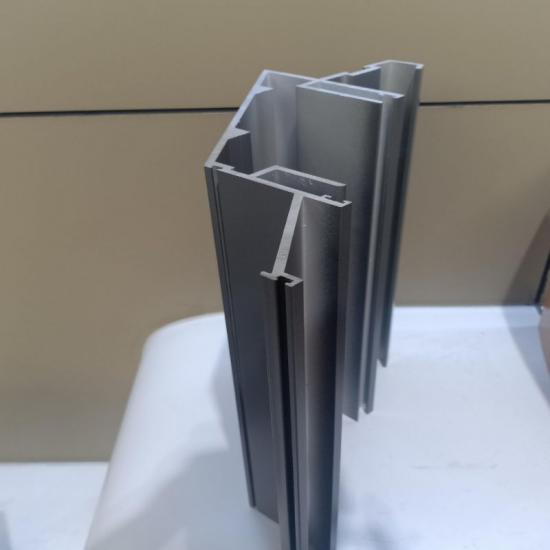
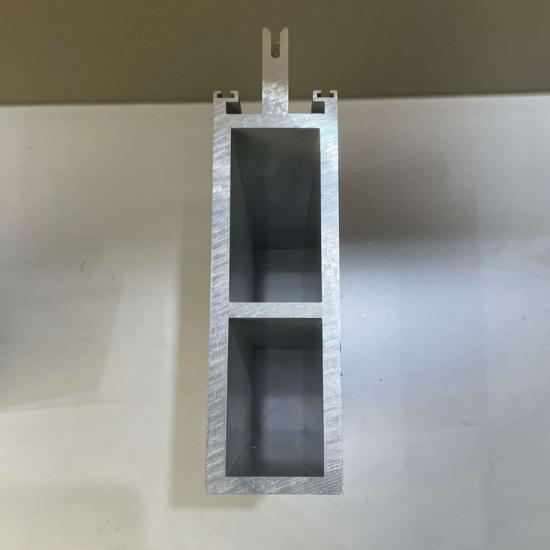
You need aluminium profiles with high strength for high-rise buildings. The strength-to-weight ratio of aluminium makes it ideal for curtain wall profiles. A typical yield point for aluminium curtain wall profiles is 160 MPa, which ensures structural stability. Thickness also matters. Thicker aluminium profiles resist wind loads and prevent deflection. Guang Ya offers a range of aluminium alloy for curtain wall applications, including high rise curtain wall aluminum profiles, which deliver long-term stable performance.

Property

Value

Unit

Yield point Rp02 min.

160

MPa


Corrosion Resistance

Aluminium curtain wall profiles face environmental factors like moisture, salt, and pollutants. Moisture enables electrochemical reactions, while salt ions and acidic gases break down the oxide layer. Dissimilar metals can cause galvanic corrosion. You can improve corrosion resistance with surface treatments. Guang Ya provides anodising and powder coating, which protect aluminium profiles from UV rays, chemicals, and weather. Anodising is sustainable and enhances corrosion resistance.

  • Moisture

  • Salt (sea air)

  • Acidic pollutants

  • Dissimilar metals contact

  • Anodising creates a protective oxide layer.

  • Powder coating offers durable weather resistance.


Thermal Performance

Energy efficiency is crucial for high-rise buildings. Aluminium curtain wall profiles with thermal breaks reduce heat transfer. These profiles use barriers to prevent heat movement, improving heat insulation performance. You can achieve U-values between 0.2 and 0.3 BTU/(h·ft²·°F), which lowers energy consumption. High-insulation versions help maintain comfortable indoor temperatures and support sustainability.

  • Effective thermal insulation reduces heat transfer.

  • Thermal break technology enhances energy efficiency.

  • Advanced aluminium profiles achieve high energy standards.


Compatibility with Glass

You must ensure aluminium profiles fit the glass type and thickness. Curtain wall profiles accommodate laminated, tempered, or double-glazed glass. Safety and thermal efficiency depend on proper frame design. Sealants and gaskets interact with aluminium profiles to retain glass. High-elongation silicone sealants allow for thermal expansion and contraction, keeping glass secure.

  • Frame design matches glass thickness.

  • Glass type affects compatibility.

  • Sealants and gaskets ensure long-term glass retention.


Sustainability

Aluminium curtain wall profiles support sustainability. Most aluminium used contains over 60% recycled material. Recycled aluminium reduces energy use and environmental impact. Using recycled aluminium aligns with LEED certifications and environmental goals. Recycling aluminium requires only 5% of the energy needed for primary production. Guang Ya offers curtain wall extrusion alloy profiles with high recycled content, making aluminium profiles recyclable and environmentally responsible.

  • High recycled content contributes to material credits.

  • Responsible sourcing supports environmental certifications.

  • Aluminium profiles are recyclable and reduce carbon footprint.


How to Choose Aluminium Profile for High-Rise Projects


Aluminum Extrusion profile manufacturer


Surface Treatment Options

You need to select surface treatments that match your project’s environment and performance goals. Surface treatments protect aluminium profiles from corrosion, enhance durability, and improve appearance. Anodizing creates a tough oxide layer that resists peeling and fading, making it ideal for outdoor and high-wear areas. Powder spraying is a popular method, offering a coating thickness of 30 microns or more. This method provides strong impact resistance, abrasion resistance, and weathering resistance. PVDF coating excels in extreme weather and UV conditions, while electrophoretic coating combines aesthetics with durability for premium applications.

Treatment Type

Key Benefits

PVDF Coating

Excels in extreme weather and UV conditions

Electrophoretic Coating

Combines aesthetics with durability for premium applications

You can choose from three main surface treatment methods for aluminium profiles. Powder spraying stands out in the market for its performance and versatility. Hard anodized films and sand powder coatings offer better corrosion inhibition compared to flat powder coatings and ordinary heat-sealing oxidized coatings. Over time, anodized finishes maintain superior performance in corrosive environments, especially in saline solutions. Powder coatings enhance both appearance and functionality, but they may fade under UV exposure. Selecting the right surface treatment ensures your aluminium profile maintains its durability and visual appeal.

Guang Ya provides a wide range of surface treatments, including anodizing, powder coating, electrophoresis, and wood grain finishes. You can customize aluminium profiles to match your design flexibility and project requirements. Their expertise in curtain wall extrusion alloy profiles allows you to achieve the desired look and performance for high-rise curtain walls.

Tip: Always match the surface treatment to your building’s location and climate for maximum durability.


Hardware Integration

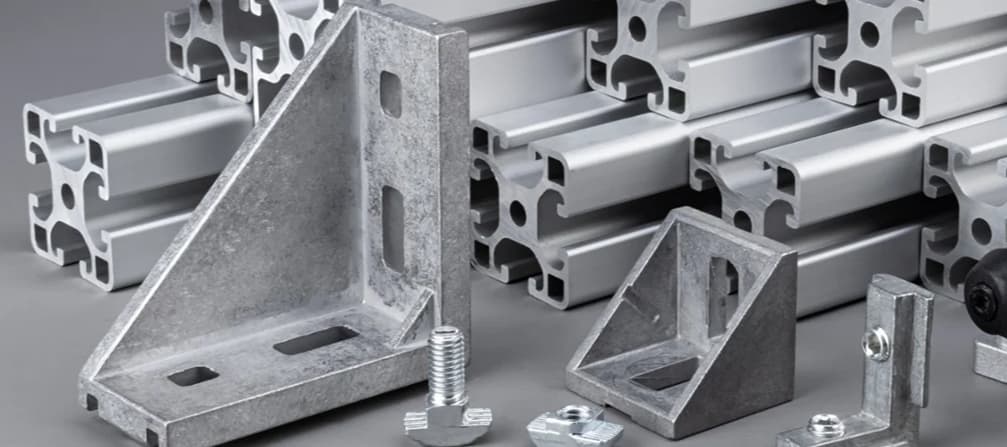
Hardware integration is crucial for the structural integrity and long-term performance of high-rise curtain wall aluminium profiles. You must ensure compatibility between aluminium profiles, glass panels, and accessories. Aluminium alloy frame profiles provide the backbone for curtain wall systems. Glass or metal panels must fit securely within the frame to maintain stability. Accessories and hardware, such as supports, corner brackets, connectors, and fasteners, play a vital role in installation precision and facade integrity.

Component Type

Role in Integration Challenges

Aluminum Alloy Frame Profiles

Provides structural integrity and compatibility with other materials.

Glass/Metal Panels

Must be compatible with the frame to ensure stability.

Accessories & Hardware

Essential for proper installation and long-term performance.

Supports, Corner Brackets

Help maintain structural stability under stress.

Connectors (Aluminum/Stainless Steel)

Ensure compatibility and reduce node mismatches.

Fasteners for Panel Mounting

Critical for installation precision and overall facade integrity.

You need to select aluminium profiles that support design flexibility and allow for seamless integration with hardware. Guang Ya offers custom fabrication services, including cutting, drilling, CNC machining, welding, and assembly. This enables you to tailor aluminium profile solutions for high rise curtain wall aluminum profiles, ensuring compatibility and ease of installation.

Checklist:

  • Confirm compatibility of aluminium profiles with glass and hardware.

  • Choose profiles with precise tolerances for easy assembly.

  • Request custom fabrication from Guang Ya for unique project needs.


Aesthetics and Frame Width

Aesthetics and frame width influence the visual impact and daylight performance of high-rise curtain walls. Sleek, modern designs create a sophisticated look and enhance the building’s appeal. Uninterrupted views and abundant daylight improve indoor environments and reduce reliance on artificial lighting. Frame width affects both the appearance and the amount of natural light entering the building. Narrow profiles maximize glass area, while wider profiles offer greater structural support.

  • Sleek, modern design enhances aesthetics.

  • Uninterrupted views create openness.

  • Abundant daylight improves mood and productivity.

Current trends in frame design include unitized systems, energy-efficient materials, smart glass technology, modular solutions, and a focus on high-rise demand. You can achieve design flexibility by selecting aluminium profiles that match your architectural vision. Guang Ya’s curtain wall extrusion alloy profiles offer a variety of frame widths and finishes, allowing you to customize profiles for both function and style.

Note: Consider the balance between structural strength and visual appeal when choosing frame width for aluminium profiles.


Maintenance and Longevity

Proper maintenance maximizes the longevity of aluminium profiles in high-rise curtain walls. Cleaning frequency depends on the environment. In common settings, clean profiles every 3 to 6 months. In harsh environments, increase cleaning to every 1-2 months. Use soft all-cotton fabric, neutral detergents, clean water, and a soft rubber wiper. Treat special stains with appropriate methods, such as a damp cloth for cement or alcohol for oily ink.

Maintenance Practice

Recommendation

Cleaning Frequency

Comprehensive cleaning every 3 to 6 months in common environments; every 1-2 months in harsh environments.

Cleaning Tools

Soft all-cotton fabric, neutral detergents, clean water, soft rubber wiper.

Special Stains Treatment

Use specific methods for different stains, such as damp cloth for cement or alcohol for oily ink.

Hardware Maintenance

Inspect screws every six months, lubricate moving parts, and clean hardware surfaces.

Sealing System

Regularly check and clean sealing gaskets, replace if damaged.

Regular Inspection

Conduct a comprehensive inspection at least once a year.

Surface Treatment Precautions

Different treatments require specific care, e.g., avoid alkaline substances for anodized profiles.

You must inspect screws every six months, lubricate moving parts, and clean hardware surfaces. Regularly check and clean sealing gaskets, replacing them if damaged. Conduct a comprehensive inspection at least once a year. Different surface treatments require specific care. For example, avoid alkaline substances for anodized profiles.

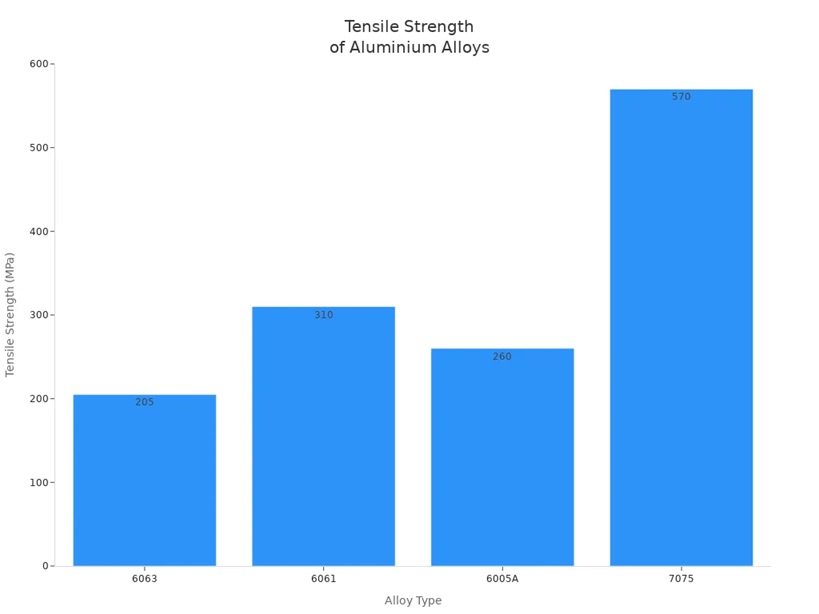
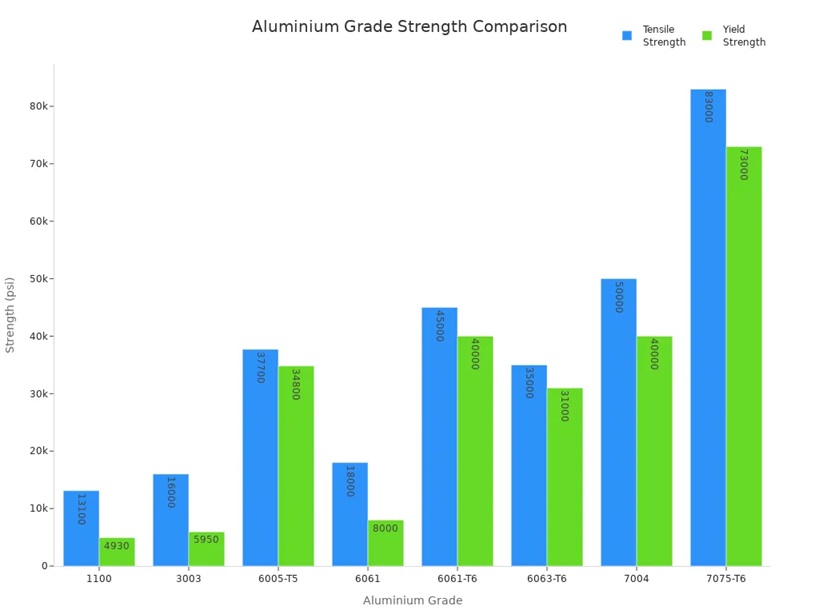
The expected service life of aluminium profiles depends on alloy selection and surface treatment. Anodizing and electrophoretic coating provide high corrosion resistance in moderate environments. Powder coating suits mild, high-humidity areas, while PVDF coating offers very high resistance in harsh outdoor or industrial settings. Alloys like 6061 and 6063 deliver strong mechanical performance and high corrosion resistance, making them ideal for curtain wall applications.

Guang Ya’s aluminium profiles are engineered for durability and easy maintenance. Their high rise curtain wall aluminum profiles and aluminium alloy for curtain wall solutions ensure long-lasting performance and reduced maintenance costs. You can rely on their expertise to select profiles that meet your project’s requirements for durability and design flexibility.

Tip: Establish a regular maintenance schedule to extend the service life of aluminium profiles and preserve their appearance.


Practical Selection Criteria for Aluminium Profiles

When choosing aluminium profiles for high-rise curtain walls, use this checklist:

  • Match surface treatment to environmental conditions.

  • Ensure hardware integration supports structural stability.

  • Select frame width for optimal aesthetics and daylight.

  • Choose profiles with proven durability and easy maintenance.

  • Request customization and fabrication from Guang Ya for unique designs.

  • Verify alloy selection for corrosion resistance and mechanical strength.

  • Confirm compatibility with glass and sealing systems.

  • Plan regular inspections and cleaning routines.

Guang Ya Aluminium Industries Co., Ltd. offers design flexibility, custom fabrication, and a wide range of aluminium profiles for high-rise projects. Their curtain wall extrusion alloy profiles and aluminium alloy for curtain wall solutions help you achieve the best balance of durability, performance, and aesthetics.


Evaluating Aluminium Profiles and Suppliers


Extrusion Profile for Curtain Wall


Reviewing Certifications and Test Data

You should always check certifications and test data before selecting aluminium profiles for high-rise curtain walls. Reliable suppliers provide full-scale tests that show how profiles perform under real conditions. Look for thermal cycling tests, which measure lifetime performance. Air and water infiltration tests help you understand how well the profiles protect your building. Common standards include TS EN 13830 and AAMA 501.4. These standards focus on air infiltration and wind load resistance, which are critical for curtain walls.

International standards like EN 755 and ASTM B221 set the rules for aluminium profiles. They define acceptable deviations for wall thickness, cross-section dimensions, straightness, and twist.

Standard

Application

EN 755

Universal specifications for aluminium and aluminium-alloy extruded profiles

ASTM B221

Compliance for extruded bars, rods, wire, profiles, and tubes

You should also review fixing methods, such as pressure plates or structural glazing, to ensure fire resistance and safety.


Supplier Reliability and Quality Assurance

You need to evaluate the reliability and quality assurance processes of your supplier. Leading companies like Guang Ya use high-grade production lines and strict quality management systems. Their professional teams provide comprehensive one-stop service, which improves customer satisfaction. You should ask about on-time delivery rates, defect rates, and how quickly the supplier responds to your questions. Request references from past clients to learn about their experience with the supplier.

Evidence Description

Details

High-grade production line

Ensures the manufacturing of quality products

Strict quality management system

Maintains high standards throughout production

Professional team providing comprehensive one-stop service

Enhances customer satisfaction and support

Tip: Always ask for client testimonials and check past project performance to assess supplier reliability.


Comparing Cost and Delivery

You must compare costs and delivery times when choosing aluminium profiles for curtain walls. The type and thickness of the profiles affect the price. Thicker profiles usually cost more but provide better structural integrity for high-rise walls. Higher-grade aluminium and advanced coatings like PVDF can increase costs by 8–12%. Installation methods and local labor market conditions also impact the total expense.

Factor

Description

Aluminium Profile Type

The type of aluminium profile affects the overall cost, with thicker profiles generally being more expensive.

Aluminium Profile Thickness

Thicker profiles provide better structural integrity but increase material costs.

Material Grade

Higher-grade aluminium can add to the cost due to enhanced properties like corrosion resistance.

Installation Methods

Different installation techniques can influence labor costs and overall project expenses.

Local Labor Market Conditions

Variations in local labor costs can significantly impact the total installation cost.

You should also check average delivery times and on-time delivery rates. Guang Ya stands out for competitive pricing, high quality, and prompt delivery, making them a strong choice for high-rise curtain walls.

Ask suppliers about their delivery schedules and how they handle urgent orders to avoid project delays.


You can achieve the best results for curtain walls by following a clear process. Start by matching alloy and surface finish to your project needs. Balance performance, durability, aesthetics, and sustainability for every high-rise. This approach supports smart buildings, saves time with unitized systems, and improves occupant health. Choosing GUANG YA Aluminium Industries Co., Ltd. gives you advanced technology, reliable quality, and custom solutions for curtain walls. Use the checklist and supplier tips to ensure your curtain walls meet all standards and support a sustainable building.

  • Smart buildings enhance comfort and energy efficiency.

  • Unitized curtain walls save labor and improve quality.

  • Innovative materials and biophilic design boost sustainability.

Criteria

Description

Alloy and Temper

Confirm specifications on all documents.

Surface Finish

Define appearance and durability expectations.

Accessory Compatibility

Check fit with all curtain wall components.


FAQ

What is the best aluminium alloy for curtain wall applications?

You should choose 6000 series alloys, such as 6061 or 6063. These alloys offer high strength, corrosion resistance, and easy fabrication. Guang Ya provides curtain wall extrusion alloy profiles that meet demanding high-rise requirements.


How do high rise curtain wall aluminum profiles improve building safety?

High rise curtain wall aluminum profiles deliver strong structural support. You get reliable wind load resistance and enhanced stability. Guang Ya’s profiles undergo strict testing to ensure safety in tall buildings.


Can I customize aluminium profiles for unique curtain wall designs?

Yes, you can request custom fabrication. Guang Ya offers cutting, CNC machining, and assembly. You select frame width, surface treatment, and alloy type to match your project’s design and performance needs.


What surface treatments protect aluminium alloy for curtain wall in harsh climates?

You should use anodizing, powder coating, or PVDF coating. These treatments shield aluminium alloy for curtain wall from corrosion, UV rays, and weather. Guang Ya provides multiple options for durable finishes.


How do I verify the quality of curtain wall extrusion alloy profiles from a supplier?

Ask for certifications, test data, and client references. Review standards like EN 755 and ASTM B221. Guang Ya supplies full documentation and maintains strict quality assurance for curtain wall extrusion alloy profiles.


How to Decide Which T-Slot Profile Fits Your Project


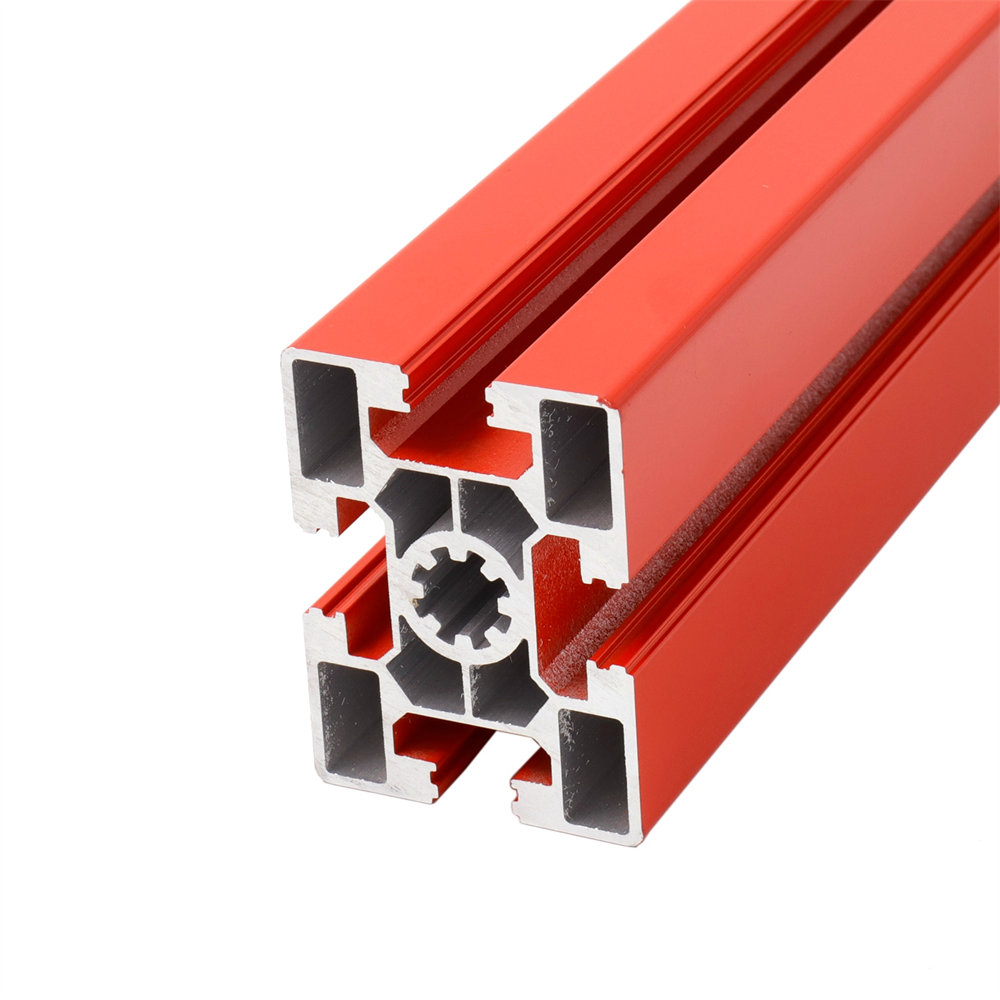
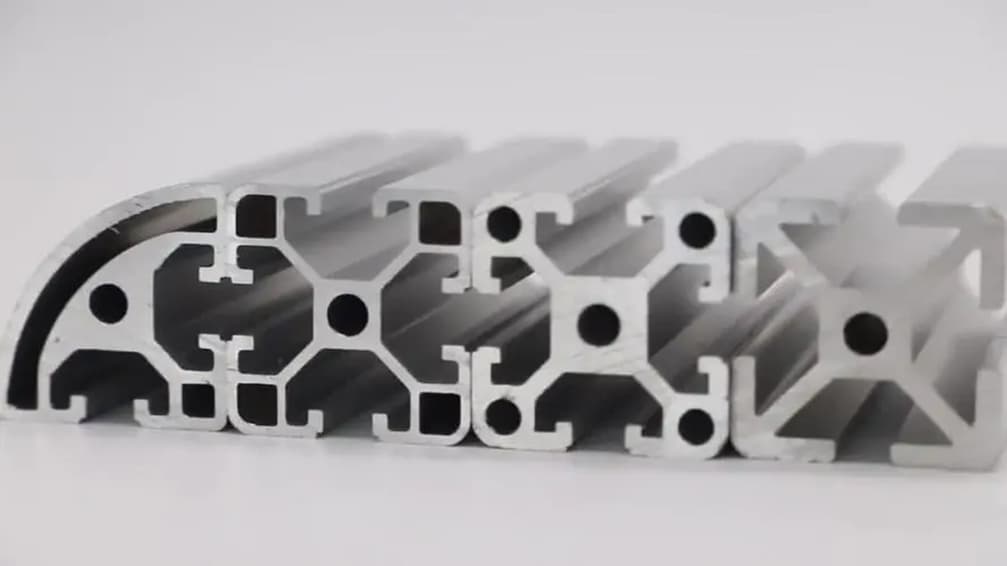
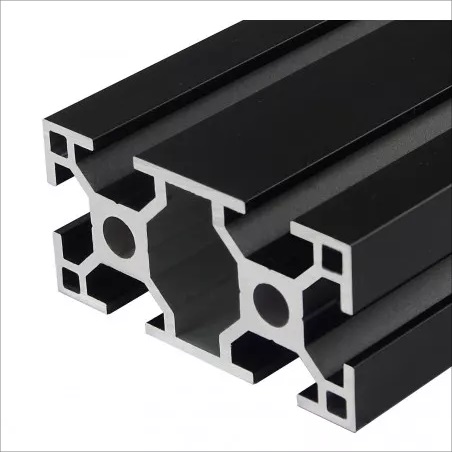
Choosing the right t-slot profile helps you make strong frames. You must measure well and know how much weight it will hold. Many factories use industrial t-slot aluminum profile for building things. More than 35% of them depend on t-slot profiles. Check the table below to see problems you may have when choosing t-slot for your project.

Factor

Description

Profile Size and Series

Bigger profiles are stronger, but shape changes how much weight they hold.

Connection Method

Strong connectors help your frame stay steady.

Allowable Deflection

Too much movement can make things not line up right.


Have you ever thought about why some frames feel strong but others shake?


Define Project Needs for T-Slot Profiles

Identify Application and Use

First, think about how you will use t-slot profiles. Every project needs something different. If you work with machines, you need strong t-slot frames. These frames must hold heavy equipment. If you build a display stand, you can use lighter t-slot profiles. Some jobs, like in cars, need profiles that handle shaking and bumps. Aerospace projects need t-slot profiles that are light but very strong.

Tip: Pick the right t-slot for your project. This helps you avoid problems later.


Determine Load and Size Requirements

You need to know how much weight your t-slot frame will hold. Guess the load first. Draw simple diagrams to help you figure it out. Do some easy math to check if your t-slot profiles are strong enough. Companies give load tables for each profile. Look at these tables to see if your choice is good. For small projects, 20x20mm t-slot works well. Medium projects use 30x30mm or 40x40mm t-slot profiles. Big jobs, like in factories, may need 45x45mm or 80x80mm t-slot profiles.

Parameter

Value

Modulus of Elasticity

70,000 N/mm²

Moment of Inertia

Profile-specific


Plan for Flexibility and Modifications

Think about what you might want to change later. Modular anodized t-slot aluminum profiles make changes easy. You can add new parts or move things around. Leave some t-slots open for later use. Build your project in sections. This way, you can make it bigger if you need to.

A key tip is to design for future changes. If you think you will add more later, keep some T-slots open and build in sections that are easy to copy or extend.

T-slot profiles help you meet new project needs. They also work in many places. If your project faces water or chemicals, pick t-slot profiles with special coatings.


Choose the Right Size T-Slot Profile

Compare T-Slot Aluminum Extrusion Sizes

You need to know the common sizes before you pick the right size t-slot profile. T-slot aluminum extrusion comes in many sizes. Each size fits a different type of project. Here are some standard sizes you will find in the market:

  • 20 mm with 5 mm T-Slot

  • 20 mm with 6 mm T-Slot

  • 30 mm with 8 mm T-Slot

  • 40 mm with 8 mm T-Slot

  • 40 mm with 10 mm T-Slot

  • 45 mm with 10 mm T-Slot

  • 60 mm with 10 mm T-Slot

  • 90 mm with 10 mm T-Slot


You will also see these shapes and sizes:

  • 15×30

  • 30×30

  • 30×60

  • 40×40

  • 45×45

  • 50×50

  • 60×60

  • 40×120

Small t-slot profiles work well for light frames and displays. Medium sizes fit workbenches and machine guards. Large t-slot profiles support heavy machines and big structures. Always check the profile size to match your project.


Assess Wall Thickness and Rigidity

Wall thickness and rigidity matter when you want your frame to stay strong. Thicker walls hold more weight and last longer. Thin walls can break or bend if you put too much load on them. For most t-slot frames, wall thickness ranges from 1.5 mm to 3.0 mm. If you build a heavy-duty frame, you need thicker walls.


Here is a table to help you see the difference:

Use case

Typical size envelope

Wall thickness

Standard length

Notes

T-slot frames

20×20 / 30×30 / 40×40 / 45×45 / 60×60

~1.5–3.0 mm

~6 m

Slot 6/8/10 mm families


You also need to think about rigidity. T-slot aluminum extrusion gives you higher rigidity for heavy loads and large spans. If you want to build a strong frame, choose a profile with a double wall design. This design helps your frame stay straight and strong, even with big loads.

Tip: For heavy-duty profiles, use thicker walls and double wall designs. These features help your frame handle more weight and last longer.


Match Profile to Load and Stability Needs

You must match your corrosion resistant t-slot aluminum profiles to the load and stability your project needs. Start by looking at the cross-sectional area. A bigger area means your profile can hold more weight. You also need to check the area moment of inertia. This number tells you how well your profile resists bending and twisting.

Here are the main points to check:

  • Cross-sectional area: Bigger area means more strength.

  • Area moment of inertia: Higher value means better resistance to bending and twisting.


For example, the 4040 t-slot aluminum extrusion can hold a lot of weight if it has thick walls and a strong shape. If you need even more strength, look at the 80 Series or 160 Series profiles. These profiles work well for large frames and machines. The 160 Series is best for very heavy loads and big support structures.

Series

Description

80 Series

Easy to install connectors and fittings. Good load-bearing capacity and stability. Can handle large loads and impacts.

160 Series

Heavy-duty and high-strength. Cross-section width about 160 mm. Best for large frames, support structures, and machines that need high stability.


When you choose the right size t-slot profile, you make your project safer and stronger. You also get the benefits of using t-slot profiles, like easy assembly and the ability to change your design later. Always check your load and stability needs before you pick your t-slot.


Select the Correct T-Slot Aluminum


Evaluate Material and Finish Options

You want your project to last a long time. The material and finish of your t-slot matter a lot. Most t-slot profiles use aluminum because it is light and strong. You can build a durable structure with strong aluminum parts. When you choose the right t-slot aluminum, you get a frame that does not rust or wear out quickly.

You also need to think about the finish. Anodizing gives your t-slot a hard surface. It protects against scratches and stops oxidation. This finish works well outdoors because it resists wear. Powder coating makes the surface even tougher. It bonds tightly to the aluminum and gives better scratch resistance than anodizing. Both finishes help your t-slot resist corrosion. If you want to use your frame outside or in a wet place, pick a finish that protects against water and chemicals.

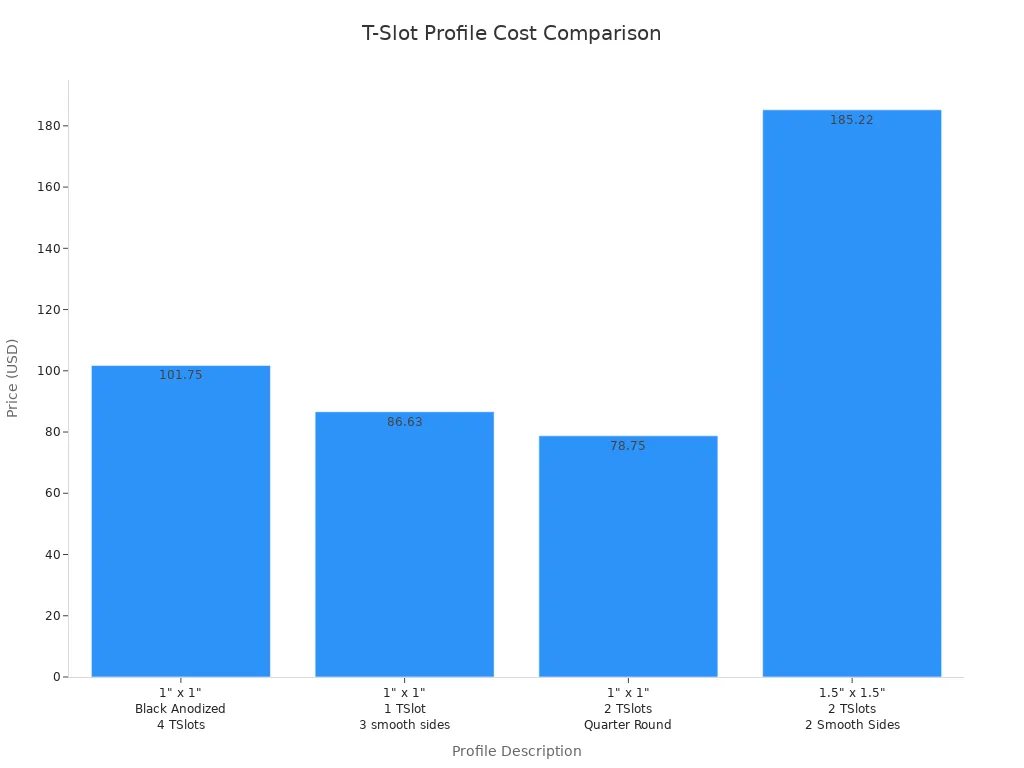
The cost of t-slot aluminum depends on the alloy, finish, and profile type. 6063 aluminum costs less than 6061. Anodized t-slot costs more at first, but you spend less on maintenance. Thicker profiles cost more but last longer and hold more weight. Modular t-slot systems save money over time because you can repair or upgrade them easily.

Bar chart comparing prices of different t-slot aluminum profiles


Check Compatibility with Accessories

You need to make sure your t-slot works with all the parts you want to use. Some accessories may not fit every t-slot profile. If you do not check, you might have problems during assembly. Look at the table below to see common issues when you select the correct t-slot and accessories.

Compatibility Issue

Description

Misalignment

Components may not align properly due to the pivot created by T-slot use.

Loosening

Tightening components can lead to loosening over time.

Reduced Stress Handling

The system may struggle to handle stress in dynamic environments.


You should always match the size and slot width of your t-slot with the connectors, brackets, and fasteners. If you use parts from different brands, check their measurements. This helps you avoid misalignment and keeps your frame stable. You want your t-slot system to stay strong and safe.

Tip: Before you buy, make a list of all the accessories you need. Check if they fit your t-slot profile. This step saves you time and money.


Consider Environmental Factors

The place where you use your t-slot frame can change how long it lasts. Outdoor factors like rain, sun, and dirt can damage your t-slot. You need to plan for these risks if you want a durable structure. The table below shows how different outdoor factors affect t-slot aluminum.

Outdoor Factor

Effect on T-slot Aluminum

Rain/sea spray

Accelerates corrosion and pitting in grooves

Sunlight/UV

Fades coatings, degrades seals or color

Temperature swings

Cause joint stress if no expansion allowance

Dirt or debris

Can trap water or wear fasteners

Mechanical wear

May loosen or obstruct joint connections


If you use your t-slot frame outside, choose the correct t-slot profile with a finish that fights corrosion. You can also add covers or seals to protect the grooves. In places with big temperature changes, leave space for the metal to expand. Clean your t-slot often to stop dirt from causing problems.

You can build a strong frame if you select the correct t-slot for your environment. Think about where you will use your frame before you buy. This helps you avoid repairs and keeps your project safe.

Note: Always check the environment before you choose the right t-slot aluminum. This step helps you build a frame that lasts.


Plan Installation and Budget

Identify Essential Accessories

You need the right accessories to build a strong t-slot frame. Start with profiles, fasteners, and panels. T-nuts and T-bolts are important because they let you attach parts anywhere along the t-slot. This makes your project flexible and easy to change. Add brackets, end caps, and surface covers for extra support and a clean look. Always check that your accessories match the size and slot width of your t-slot. If you use panels, make sure they fit inside the grooves.

Tip: Make a checklist of all accessories before you start. This helps you avoid missing parts during assembly.


Estimate Costs and Modifications

You can plan your budget by following a few steps. First, write down your project needs, like size, load, and where you will use the frame. Choose the right profile size for your t-slot. Larger profiles cost more but give you more strength. Pick aluminum for most projects because it is light and resists rust. Check that your slot size matches your connectors and fasteners. Calculate the load your frame will hold. Select connection methods that let you take things apart if needed. Look for profiles that allow easy changes or upgrades. Balance your budget with the strength and features you need. Ask your supplier about support and delivery times. If your project needs a special look, consider the finish. Make sure your t-slot works with other parts you already have. Check for any rules or standards you must follow.

Note: Planning for future changes can save money. Modular t-slot systems let you add or remove parts without starting over.


Prepare for Assembly and Expansion

Get ready for assembly by gathering all your materials. Plan your design and layout before you start. Cut your t-slot profiles to the right lengths. Wear safety gear like gloves and goggles to protect yourself from sharp edges and metal shavings. Use clamps to hold profiles steady when you cut or drill. Attach connectors and fasteners tightly. Build your frame step by step. Add accessories like panels or covers after the main frame is done. Test your structure for stability and make adjustments if needed.

If you want to expand your project later, design your frame with open slots and extra space. Use gussets to keep rectangular frames from twisting. Calculate how many fasteners you need for strong joints. Orient your profiles for the best strength. Regularly check your t-slot frame for wear or dirt. Apply a lubricant to protect against rust and keep moving parts smooth.


Safety Table:

Hazard

Prevention

Sharp Edges

Wear cut-resistant gloves

Falling Profiles

Use clamps and secure brackets

Eye Injury

Wear safety glasses

Lifting Strains

Use team lifting or mechanical aids

Electrical Tools

Check cords and grounding


You can build a safe and strong project if you plan each step and use the right t-slot accessories.


You can pick the best t-slot profiles if you follow some easy steps. First, choose if you want metric or inch profiles. Next, think about how much weight your t-slot will hold and how big it should be. Check your numbers and make sure you can change things later if needed. Look at different choices and talk to people who know a lot about t-slot profiles.

Supplier Method

Description

Local Manufacturers

You can find good profiles close to where you live.

Online Directories

These help you see many suppliers and products.

Trade Shows

You can meet experts and talk about your project.


Make sure you think about what you need before you buy anything.


FAQ

What is a t-slot profile?

A t-slot profile is an aluminum extrusion with a T-shaped groove. You use it to build frames, workstations, or machine guards. The groove lets you attach parts and accessories easily.


How do you measure the right t-slot size?

You measure the width and height of the profile. Check the slot width for accessory fit. Use a ruler or caliper for accuracy. Always compare your measurements with manufacturer charts.


Can you cut t-slot profiles at home?

Yes, you can cut t-slot profiles with a saw. Use a fine-tooth blade for clean edges. Wear safety gloves and goggles. Clamp the profile before cutting to keep it steady.


What accessories work with t-slot profiles?

You can use T-nuts, bolts, brackets, end caps, and panels. Check the slot width and profile size before buying accessories. Most suppliers list compatible parts in their catalogs.

How to Ensure You Choose the Best Custom Aluminium Profile Manufacturer

The right aluminium profile supplier shapes your project’s outcome. When you assess manufacturers, you need to match their capabilities with your specific requirements. Understanding your needs for a Custom Aluminium Profile lets you select the right type and ensures the product fits your design and timeline. Early discussions with manufacturers help you make informed design choices and plan resources, which leads to better integration with other components and greater project efficiency.


Key Takeaways

  • Check the manufacturer’s material standards and alloy options. Choosing the right alloy improves strength and durability.

  • Prioritize quality control and certifications. Certifications like ISO 9001 and QUALICOAT ensure reliable, high-quality profiles.

  • Ensure the manufacturer offers a wide range of custom profiles. Flexibility helps match your project needs precisely.

  • Evaluate the manufacturer’s experience and reputation. A proven track record guarantees consistent results and good support.

  • Understand lead times and delivery options. Reliable delivery keeps your project on schedule and reduces delays.


Quality and Certifications

Architecture Aluminium Profile

Material Standards and Alloy Grades

You should always start by checking the material standards and alloy grades a manufacturer offers. The right alloy grade impacts the strength, machinability, and lifespan of your custom aluminium profiles. For high-performance industrial applications, certain grades stand out for their mechanical properties and durability:

Alloy Grade

Properties

Typical Uses

6005

Good extrusion performance, improved strength

Structural systems, transportation equipment, heavy-duty mechanical frames

6082

High strength, excellent mechanical properties, good corrosion resistance

Industrial structural applications in demanding environments

7075

High strength, excellent mechanical performance

Aerospace components, high-load mechanical structures

Selecting the right alloy ensures your profiles meet both performance and quality expectations.


Surface Finish Options

Surface finish plays a key role in both the appearance and the long-term quality of your aluminium profiles. You can choose from several finishing options, each offering unique benefits:

Feature

Anodizing

Powder Coating

Painting (Wet)

Mechanical Finish

Primary Benefit

Durability, Wear

Versatility, Tough

Color Options

Texture, Look

Corrosion Res.

Good to Excellent

Excellent

Good

Varies (Base)

Appearance

Metallic/Colors

Wide Color/Texture

Wide Color

Satin to Mirror

Relative Cost

Moderate

Moderate

Moderate

Low to Moderate

Anodizing enhances the surface, providing excellent resistance to abrasion and wear. Powder coating adds vibrant color and extra protection. Mechanical finishes like brushing or polishing give your profiles a unique texture and look. The right finish improves both the durability and the quality of your final product.


Quality Control and Certifications

You need to verify that your manufacturer follows strict quality control processes. These processes ensure every profile meets your specifications and industry standards. Key quality control steps include:

  • Design verification with detailed checks and client collaboration

  • Real-time extrusion process monitoring for temperature and pressure

  • Surface treatment inspection for uniform coating and color consistency

  • Final product testing, including mechanical and dimensional checks

Leading manufacturers hold certifications such as QUALICOAT, QUALANOD, GSB International, and NF Certification by CSTB. These standards guarantee quality coating, anodizing, and thermal insulation. ISO 9001 certification demonstrates a commitment to ongoing audits and process improvement. ISO 14001 and IATF 16949 further enhance reliability by focusing on environmental management and supply chain stability.

Tip: Inadequate quality control can lead to raw material inconsistencies, structural defects, and increased production costs. Always ask for documentation of quality checks and certifications before you commit.

By prioritizing quality at every stage, you ensure your custom aluminium profiles deliver the performance and reliability your project demands.


Customization and Project Requirements

Industrial Aluminium Profile

Profile Range and Design Flexibility

You need a manufacturer who offers a broad selection of custom profiles to match your project requirements. Leading suppliers provide a wide variety of profile shapes and sizes, including trim caps, rods, angles, bars, and channels. You can request T-shaped profiles for beams or trims, or choose from a range of other configurations. Top manufacturers can produce highly customizable aluminum shapes to precise dimensions, giving you the flexibility to achieve the exact profile shape and size your project demands. This level of customization possibilities ensures your design vision becomes reality.


Application Needs and Specifications

Every project comes with unique requirements. You must assess whether the manufacturer can deliver custom profiles that meet your technical needs, such as load-bearing capacity and environmental resistance. Manufacturers use different aluminum alloys, including 1000, 3000, and 6000 series, to balance conductivity, strength, and corrosion resistance. They also offer machining and finishing options like cutting, drilling, anodizing, and powder coating. These processes create custom aluminium profiles that withstand harsh conditions, including outdoor environments. Anodizing and powder coating add layers of protection, making your profiles resistant to UV rays, salt spray, and industrial atmospheres.


Engineering Support for Custom Aluminium Profile Projects

You benefit from strong engineering support throughout your projects. Leading manufacturers provide design and engineering assistance, helping you turn concepts into technical drawings. They offer full machining capabilities for extrusions and accessories, ensuring your custom profiles meet all specifications. Installation services and personalized project support help you avoid costly mistakes and delays. You should also consider die fabrication timelines. Most top manufacturers complete die fabrication in three to five weeks, with samples available about two weeks later. This efficiency keeps your project on schedule and ensures you receive the right profile shape and size for your application.

Tip: Early collaboration with your manufacturer streamlines customization and helps you address project requirements before production begins.


Supplier Experience and Reputation

Track Record with Custom Aluminium Profile Projects

You should always investigate a manufacturer’s track record before making a decision. A strong history with custom aluminium profile projects shows that the company can handle complex requirements and deliver consistent results. Look for suppliers with recognized certifications like ISO 9001. These certifications prove that the manufacturer follows standardized quality processes. Ask about their Quality Management System and inspection procedures. This information gives you objective insight into their quality control practices. You should also check if the manufacturer offers prototype development and Design for Manufacturability feedback. These services demonstrate technical support and commitment to your project’s success. Review their history of on-time delivery and responsiveness to inquiries. Reliable communication and punctuality reflect a supplier’s reliability and reputation.


Technical Expertise and Equipment

Technical expertise sets leading manufacturers apart. You want a supplier with advanced equipment and skilled engineers. Modern factories use CNC machining, precision extrusion, and advanced welding techniques to achieve tight tolerances and high-quality finishes. For example, CNC bending machines and laser engraving tools allow for intricate designs and consistent results. Many top suppliers invest in research and development to improve their processes. They use simulation software for 3D modeling and online quenching equipment for precise extrusion. Certifications such as AS9100, ISO9001, and ISO14001 further confirm their technical capabilities. These factors ensure your custom aluminium profiles meet demanding industry standards.

Technique

Description

CNC Machining

Achieves precise dimensions for complex shapes.

Precision Extrusion

Delivers profiles with exact specifications.

Surface Treatments

Enhances durability and appearance.

Advanced Welding

Provides strong, reliable joints.

Metal Extrusion Simulation

Uses 3D modeling to solve production challenges.


References and Reputation in the Industry

You should always check references and assess supplier reputation in the industry. Ask for case studies or testimonials from clients with similar projects. This step helps you understand how the supplier handles challenges and meets expectations. Industry experts recommend evaluating manufacturing capabilities, certifications, and global reach. The table below summarizes key criteria for assessing reputation:

Criteria

Description

Manufacturing Capabilities

Proven production capacity and advanced machinery.

Certifications

ISO-certified manufacturers ensure quality control.

Industry Reputation

Established companies with years of experience in the market.

Global Reach

Ability to export and meet international standards.

You can also review key performance indicators such as quality control processes, compliance with international standards, and technical support capabilities. Reliable suppliers provide comprehensive QC documentation and welcome third-party inspections. These actions build trust and reinforce supplier reputation.

Tip: Always request references and conduct factory audits when possible. This approach helps you verify supplier experience and reputation before you commit.


Lead Times and Delivery Reliability

Production Schedules for Custom Profiles

You need to understand the production timeline before you start your custom extrusion  aluminium profile project. The typical lead time for these profiles ranges from 20 to 25 days. This period covers several steps:

  • Confirming design drawings with your supplier

  • Creating the mold for your custom profile

  • Approving samples to ensure specifications match your requirements

  • Moving to mass production

  • Preparing the final shipment for delivery

In urgent situations, manufacturers can sometimes shorten this process to just 7 to 10 days. You benefit from working with suppliers who offer expedited shipping options and dynamic scheduling. Some companies outsource specific production stages to specialized partners, which helps them meet tight deadlines. Effective communication across the production and supply chain teams prevents delays. Prioritizing orders and using advanced technologies, such as 3D printing, can also reduce the lead time and delivery window.

Tip: Ask your supplier about their ability to adapt schedules for urgent or complex orders. This flexibility can make a significant difference in your project’s success.


On-Time Delivery and Logistics

You rely on timely delivery to keep your project on track. Leading manufacturers use robust packaging, including foam and wooden pallets, to protect your aluminium profiles during transit. They select the best transportation modes for your order size and destination. Security measures, such as GPS tracking and secure warehousing, help prevent loss or damage. Manufacturers analyze potential hazards and create contingency plans to address disruptions. For international shipments, sea freight offers an economical solution for bulk orders and heavy loads.

You should always choose a supplier with a proven record of timely delivery and strong logistics support. Reliable delivery ensures your materials arrive when you need them, reducing downtime and avoiding costly project delays.

Note: Consistent lead time and delivery performance builds trust and helps you plan your resources more effectively.


Value and Pricing

Transparent Pricing for Custom Aluminium Profiles

You need a supplier who provides clear and detailed pricing for every custom aluminium profile order. Leading suppliers break down the cost into key components. These include raw material prices, die manufacturing, extrusion processing, heat treatment, surface finishing, and machining costs. You often see references to market exchange prices like LME and SHFE, which help you verify that the cost reflects current market rates. A reliable supplier will give you a detailed quote and explain each line item. This transparency allows you to compare offers and understand where your investment goes. You can request consultations to clarify any part of the cost structure. This approach ensures you avoid hidden fees and unexpected charges.

Cost Component

Description

Raw Material

Based on market rates (LME, SHFE)

Die Manufacturing

Custom tooling for your profile

Extrusion Processing

Shaping and forming the aluminium

Heat Treatment

Enhances material quality and finish

Surface Finishing

Anodizing, powder coating, or other finish types

Machining

Cutting, drilling, or additional fabrication

Tip: Always ask your supplier for a full breakdown of the cost. This step helps you make informed decisions and ensures the product quality matches your expectations.


Balancing Cost, Quality, and Service

You must look beyond the lowest cost when choosing a supplier. The right balance between cost, product quality, and service determines the long-term value of your investment. Several factors influence the total cost:

  • Tooling costs can vary between suppliers. New dies, testing, and validation add to the initial investment.

  • Profile complexity, size, alloy type, and finish requirements all impact the final price.

  • Production capacity, experience, and customization options affect both cost and delivery reliability.

  • Quality control and logistics support ensure you receive consistent material quality and finish.

You should evaluate how well the supplier’s profiles integrate with other materials. Poor integration can lead to structural weaknesses and higher maintenance costs. Prioritize suppliers who offer strong customer support and clear communication. These suppliers help you avoid costly mistakes and delays. A long-term partnership with a reputable supplier often results in better pricing, improved finish, and consistent product quality over time.

Note: The lowest price does not always mean the best value. Consider material quality and finish, supplier reliability, and customer support when making your final choice.


You secure project success by evaluating quality, customization, experience, delivery, and value. Industry experts recommend using a checklist to assess suppliers. Review visual inspections, surface roughness, coating consistency, and mechanical tests. Avoid common mistakes by checking supplier capabilities, certifications, and communication. Use the table below as your guide:

Common Mistakes

How to Avoid Them

Not evaluating capabilities

Seek integrated CNC machining centers

Ignoring red flags

Verify certifications and stock consistency

Focusing solely on price

Beware of price undercuts and poor materials

Lack of communication

Choose responsive technical support

Use these criteria to make confident decisions and build lasting partnerships.


FAQ

What should you look for in an aluminium profile supplier?

You need to check the supplier’s experience, technical capabilities, and certifications. Reliable aluminium profile supplier offers consistent quality, strong engineering support, and clear communication. You secure your project by choosing a supplier who meets your requirements and delivers aluminum profiles on time.

How do you ensure aluminum profiles match your project requirements?

You must provide detailed specifications and collaborate with the aluminium profile supplier early. You review drawings, select the right aluminium alloy, and confirm surface finishes. You verify that the aluminum profiles meet your project requirements before production starts.

Can you customize aluminium profiles for unique project needs?

You can request custom shapes, sizes, and finishes from your aluminium profile supplier. You discuss your requirements and project goals with their engineering team. You receive aluminum profiles tailored to your application, ensuring your project achieves the desired performance.

What certifications should your aluminium profile supplier have?

You should look for ISO 9001, QUALICOAT, and QUALANOD certifications. These standards guarantee quality control and consistent aluminum profiles. You confirm that your aluminium profile supplier meets industry requirements and supports your project with reliable aluminium products.

How do you manage lead times for aluminum profiles in your project?

You plan your project timeline with your aluminium profile supplier. You confirm production schedules, review sample approval processes, and track delivery. You avoid delays by choosing a supplier who communicates clearly and delivers aluminium profiles according to your requirements.

How to Spot High Precision Fluorocarbon Aluminum Profiles for Window Use

You can find a high precision fluorocarbon aluminum profile for windows by looking for neat cuts. Check if it has the right weight. The surface should feel smooth. The color should look the same everywhere. Look for anodization on the profile. Ask suppliers for performance data sheets. Match your window needs to where and how you will use them. Good profiles should not have any defects. They need strong wall thickness. The finish should be even and consistent. The table below lists common quality signs for window profiles:

Quality Indicator

Description

Appearance quality

Smooth, clean finish with no defects

Wall thickness

At least 1.4mm thick for outside window profiles

Film thickness

Meets anodized rules like AA10, AA15, AA20, AA25

Chemical composition and properties

Must follow technical rules

Color difference

Same color for nice looking windows

Anti-corrosion and abrasion resistance

Makes windows last longer and stay strong


Project Needs for Aluminium Window Profile

Window Design and Application

When picking aluminum window profiles, think about how your window will look and work. Each window type needs different things. Sliding windows, casement windows, and fixed windows all use aluminum window profiles in their own way. You want your window to keep air from leaking. This helps your home stay comfy and saves energy. Air-tight windows also stop dust and noise from getting in.


Heavy-duty fluorocarbon finished aluminum profiles have many good points for window design. They come in lots of colors and finishes, so you can pick what you like. These profiles make your windows look neat and modern. They also fight off rust and oxidation, so your windows stay nice for a long time. The table below lists some important features:

Feature

Description

Corrosion Resistance

Excellent resistance to corrosion and weathering, making it suitable for various environments.

UV Resistance

Protects against strong ultraviolet radiation, preventing fading and discoloration.

Durability

Maintains long-term performance without fading or powdering, ensuring longevity.


You should check how water drains from the window. Good aluminum window profiles use hidden water drainage or a sinking water draining system. These designs help stop water from getting inside and keep the frame dry. Good draining and sealing keep your window safe from leaks and damage.


Load and Environmental Requirements

Think about where you will put your window. Aluminum window profiles need to handle different weights and weather. In places near the sea, salty air can cause pitting corrosion. In cities, things like sulfur dioxide can hurt the surface. Very high or low pH can damage the oxide layer on the aluminum window profiles.


The table below lists key environmental factors:

Environmental Factor

Considerations

Application Scenario

Residential, commercial, or high-rise structures; consider coastal or cold climates.

Corrosion Resistance

Select products based on exposure to high salinity or extreme pH conditions.

Thermal Performance

Evaluate thermal enhancement needs based on local climate conditions.


Pick aluminum window profiles that fit your local weather. If you live where it rains a lot, focus on draining and sealing. For cold places, choose profiles with good thermal performance. Always check if the aluminum window profile can hold the glass and frame. This helps your window last longer and work well.


Quality Indicators of High Precision Fluorocarbon Aluminum Profile

Neat Cuts and No Burrs

You can check for good aluminum profiles by looking at the edges. The corners should look straight and smooth. There should not be any rough spots or burrs. Burrs are small pieces of metal left after cutting. They can hurt your hands or make the window hard to put together. If you see gaps or uneven cuts, the profile was not made carefully. When you touch the surface, it should feel smooth. Jagged edges or leftover metal mean the profile is not high quality. Always look at the corners and where the pieces join. Neat cuts help windows fit tight and keep out air and water.

Tip: Hold the profile up to the light. You can see small gaps or rough spots better this way.


Weight and Alloy Quality

The weight of a profile tells you about its quality. Good aluminum alloys have a certain weight because of the metals used. If the profile feels too light, the walls may be thin or the alloy is not strong. You want a profile that feels solid but not too heavy. The right weight helps the profile hold the glass and frame. Good aluminum alloy profiles use strong alloys like 6063-T5 or 6061-T6. These alloys make the profile strong and long-lasting. You should ask the supplier what alloy they use and check if it fits your project.

Here is a quick checklist for weight and alloy quality:

  • The profile should feel sturdy and balanced.

  • The supplier should list the alloy type, such as 6063-T5 or 6061-T6.

  • The wall thickness should be at least 1.4mm for window use.

  • High quality aluminum alloys resist bending and breaking.


Surface Finish and Chromaticity

The finish of the profile shows if it is good quality. The surface should look smooth and even. There should not be stains, scratches, or dents. Chromaticity means the color looks the same everywhere. If you see color changes or spots, the finish is not good. Good aluminum alloy profiles have even color and shine. The finish keeps the profile safe from weather and makes the window look nice. You can use your eyes and hands to check the surface. Run your fingers along the profile. It should feel slick and even. Look for dull spots or shiny patches. These show poor quality.

Note: Chromaticity is important for decorative windows. Even color makes the window look neat and professional.


Anodization and Color Uniformity

Anodization puts a protective layer on the profile. This layer keeps the profile safe from rust and fading. You can check anodization by looking at the color. Good aluminum profiles have colors that match from batch to batch. Color difference is measured with Delta E (ΔE) values. A ΔE value of 2 or less means the colors look the same to your eyes. Special tools called spectrophotometers measure these values.


Here is a table showing the benchmarks for color uniformity:

Standard

Acceptable Delta E

ASTM B244

≤ 2

ISO 7599

≤ 2


For decorative or brand products, the ΔE should be 2 or less. For technical parts, a ΔE of 3 is okay. The American Architectural Manufacturers Association (AAMA) allows a ΔE up to 5, but good anodizers try for 1 to 3.

Benchmark

Acceptable Delta E Range

AAMA Specification

≤ 5

High-Quality Anodizers

1 to 3

Technical Parts

≤ 3

Decorative Products

≤ 2

Bar chart comparing Delta E color uniformity benchmarks for anodized aluminum profiles

You should ask your supplier for test reports. These reports show the Delta E values for each batch. If the values are below 2, the profile has good anodization. Even color means your window will look nice and last longer.

Spectrophotometers help measure color differences. If the Delta E is 2 or less, the colors look the same to your eyes.


Durability and Performance Evaluation

Weather Resistance and Oxidation

You want your window to last a long time. Durability is very important when picking corrosion-resistant fluorocarbon aluminum profiles for coastal areas. These profiles must stand up to rain, sun, and pollution. Check if the window profile has a strong surface layer. This layer stops oxidation and keeps the color bright. Salt in the air or acid rain can hurt weak profiles. Look for pitting or white spots on the surface. These signs mean the profile is not durable and does not perform well.

Good window profiles have high durability and performance ratings. They keep their shape and color even in bad weather. Ask your supplier about water-proof performances. This means the window will not leak in heavy rain. You can also ask about insulation properties. Good insulation keeps your home warm in winter and cool in summer. This comes from strong thermal performance and proper sealing.

Tip: Run your hand along the profile. If it feels smooth and even, it shows high quality and durability.


Performance Data Sheets and Standards

Always ask for performance data sheets before you buy. These sheets show how the window profile works in real tests. You can find information about durability, thermal performance, and insulation. The data sheets also list ratings for weather resistance and strength.

Many suppliers follow international standards. These standards help you compare durability and performance ratings. Some important standards are:

  • AAMA specifications for window profiles

  • ASTM standards for durability and performance

  • ISO standards for thermal performance and insulation properties

You can use these standards to check if the window profile fits your needs. Look for performance ratings on the data sheet. High ratings mean the profile will last longer and protect your home better. Also check for water-proof performances and thermal insulation. These features make your window more durable and perform better.

Note: Always keep a copy of the performance data sheets. They help you compare products and pick the best one for your project.


Comparing Aluminium Window Profile Suppliers

Documentation and Certifications

You should ask your supplier for documents before buying window profiles. These papers show the profiles meet quality rules. They help you avoid extra costs later. Guang Ya aluminium will give clear records for each window profile. The table below lists important documents and certifications you should check:

Document Type

Purpose

Issued By

Mill Test Report (MTR)

Confirms alloy composition and properties

Manufacturer

Dimensional Inspection Report

Verifies profile size and tolerance

Quality department

Surface Inspection Report

Confirms surface finish quality

Inspection team

Certificate of Conformity

Declares product meets contract specs

Manufacturer

ISO 9001

Quality management system

Manufacturing

RoHS Compliance

Limits hazardous substances

Electronics

SGS Inspection Report

Third-party verification

International trade


These documents prove the profiles follow quality rules. You can trust a supplier who shares these records. This step helps you avoid paying more for bad quality or missing papers.


After-Sales Support and Warranty

A good supplier gives you more than just window profiles. You get after-sales help and a strong warranty. These protect your windows and save money later. Look for these signs of good service:

  • Long warranties protect you from defects and damage.

  • Good suppliers have teams to help you. They fix problems fast and use real parts.

  • A strong warranty means the supplier trusts their window profiles. This trust can make your property worth more and lower repair costs.

Always check the warranty details. Good support means you spend less on fixing windows and get help when needed.


Supplier Reputation

You want a supplier you can trust for your window project. A good reputation means better quality and fewer hidden costs. Check these things when you compare suppliers:

  • Quality of window profiles

  • Customer reviews and feedback

  • Industry certifications that show quality standards

  • Helpful customer service

A good supplier meets deadlines, answers your questions, and gives fair prices. You can save money and avoid trouble by picking a supplier with a strong name in the window business. Guang Ya Aluminium Industries welcome you to visit our factory. 


Practical Tips for Spotting Quality Profiles for Windows

Visual Inspection Techniques

You can start by looking closely at each window profile. Begin with a visual inspection to spot any surface issues. Check for scratches, dents, or discoloration. Make sure the color looks the same across the whole profile. Look for a consistent surface finish. If you see peeling, bubbling, or uneven coating, the profile may not last long. Watch out for warping or irregular shapes. These can make it hard to fit the window into place. Use your hands to feel for rough spots or sharp edges. A smooth finish shows good quality.

  • Look for scratches, dents, or stains on the surface.

  • Check for color that matches across all parts.

  • Inspect for warping or irregular shapes.

  • Feel for roughness or sharp edges.

  • Watch for peeling or bubbling on the coating.

Tip: Hold the profile up to the light. This helps you see defects that are hard to spot.


Requesting Samples and Test Reports

You should always ask for samples before you buy window profiles. Samples let you see and touch the product. You can check if the profile fits your window design. Ask the supplier for test reports. These reports show the mechanical properties, like tensile strength and yield strength. They also show if the profile meets industry standards. Reviewing these reports helps you make smart choices for your windows.

  • Request samples to check fit and finish.

  • Ask for quality inspection reports.

  • Review test results for tensile strength and durability.

  • Make sure the reports match your window needs.


Asking Key Questions

When you talk to suppliers, ask questions to learn more about their window profiles. Find out if they make the profiles themselves or work with trusted partners. Ask about their cutting and assembly process. Check if they have strong quality control and batch tracking. Make sure they offer custom sizes for your window project. Ask about warranty terms and support. Good suppliers give clear answers and help you choose the right windows.

  • Do you make the profiles in-house or use trusted partners?

  • What cutting and assembly methods do you use?

  • How do you check for quality during production?

  • Can you provide custom sizes for my window?

  • What warranty and support do you offer?

  • What material grade and surface finish options are available?

  • Do you have experience with large or special window designs?

Note: Asking these questions helps you find a supplier who cares about quality and supports your window project from start to finish.


You can find high precision fluorocarbon aluminum profiles by using simple steps. First, look at the profile for neat cuts and smooth surfaces. Ask the supplier for performance data and certifications. Good suppliers help you pick profiles that fit your windows. When you check quality signs, your window gets better air tightness, water tightness, wind load resistance, thermal insulation, sound insulation, structural strength, and surface finish durability. These steps help your window last longer and look nice. Use these tips to choose the best profiles for your window project.

  • Air tightness keeps your window comfy.

  • Water tightness stops rain from getting in.

  • Wind load resistance keeps your window safe.

  • Thermal insulation saves energy.

  • Sound insulation makes things quieter.

  • Structural strength holds up your window.

  • Surface finish durability keeps your window looking new.

Remember, checking carefully and picking a reliable supplier helps your window project succeed.


FAQ

What is fluorocarbon coating on aluminum profiles?

Fluorocarbon coating stops aluminum profiles from rusting and fading. It makes the surface tough and keeps out bad weather and UV rays. This coating helps window frames stay new for a long time.


How can you check if an aluminum profile is high precision?

Look at the profile for straight cuts and smooth surfaces. Make sure the color looks the same everywhere. Ask for data sheets and certificates. High precision profiles feel strong and fit together with no gaps.


Why does wall thickness matter for window profiles?

Wall thickness makes your window strong and last longer. Find profiles with at least 1.4mm thickness. Thicker walls help windows stay safe from bending and breaking.


Can you use fluorocarbon aluminum profiles in coastal areas?

Yes, you can use fluorocarbon aluminum profiles near the coast. The coating keeps out salt and moisture. Your windows stay strong and do not rust in tough places.

Key Advantages of Custom Aluminium Profiles for Building and Industrial Applications

You can achieve outstanding results in architecture and construction by choosing custom aluminium profiles. These profiles offer unique benefits like lightweight strength, excellent corrosion resistance, and unmatched design flexibility. Aluminium profiles help you reduce costs and simplify installation. The demand for custom aluminium profile solutions keeps rising, especially as industries look for ways to boost efficiency and performance.

  • The custom aluminium profiles segment is expected to grow at a CAGR of 8.2% as more projects require tailored solutions.

  • By 2026, the building and construction sector may account for 35.9% of the extruded aluminum profiles market.

When you compare materials, you see clear advantages:

Material

Strength-to-Weight Ratio

Corrosion Resistance

Aluminum

High

Excellent

Steel

Moderate

Moderate

You gain reliability and long-term value with custom aluminium sections, even in tough environments.


Key Takeaways

  • Custom aluminium profiles offer lightweight strength and excellent corrosion resistance, making them ideal for various building and industrial applications.

  • The design flexibility of aluminium profiles allows for tailored solutions, enabling you to create complex shapes that meet specific project needs.

  • Using custom aluminium profiles can significantly reduce production waste and costs, enhancing overall project efficiency and sustainability.

  • Aluminium profiles are 100% recyclable, supporting environmental goals and reducing the carbon footprint of your projects.

  • Consulting with experienced suppliers ensures you select the right aluminium profiles and joining methods, maximizing performance and durability.


Design Flexibility of Custom Aluminium Profiles

Custom Aluminium Profiles

Custom aluminium profiles give you the power to create solutions that match your exact project needs. You can choose from a wide range of custom shapes and designs, making it easy to address complex architectural or industrial challenges. This design flexibility means you can adapt aluminium sections for almost any application, from intricate frameworks to robust support structures.


Versatile Shapes and Sizes

You will find that aluminium profiles come in many forms. Some of the most common shapes and sizes include:

  • Angles for support structures and brackets

  • Channels used in framing and construction

  • Tubes and rods for frameworks and mechanical parts

  • Solid shapes like squares, rectangles, rounds, and hexagons

  • Hollow shapes such as tubes and channels

  • Specialized profiles like I-beams, Tees, Zees, and bars

Each shape offers unique benefits. For example, I-beams support heavy loads, while T-slots allow you to build flexible frames. The versatility of aluminium sections lets you select the best profile for your project, whether you need strength, lightness, or adaptability.

Recent projects highlight the benefits of custom aluminium profiles. The table below shows how custom designs solve real-world challenges:

Project Description

Outcome

Developed a hollow-core hexagonal profile with internal cooling channels for a robotics client

Reduced component weight by 40% compared to solid aluminum parts

Redesigned solar panel mounting system using 6063-T6 profiles

Reduced installation time by 30% while maintaining IEC 61215 certification requirements

You can also see the impact in large-scale construction. For example, a major airport terminal used over 870 different profile types to create a wavy roof structure, showing how custom aluminium profiles adapt to complex designs.


Integration with Other Materials

You often need to combine aluminium profiles with other materials. This integration can present challenges. Aluminium’s low melting point and thermal sensitivity may cause weak joints if you use the wrong joining method. You might also face issues like deformation or tool wear during CNC machining. To overcome these challenges, you should optimize machining parameters and select the right tools.

The alloy and finish of aluminium sections affect their strength and weldability. You must consider these factors when planning integration. Advances in technology, such as precision engineering and CNC machining, help you achieve a perfect fit and reliable performance. These innovations make it easier to use custom aluminium profiles in combination with steel, glass, or composite materials.

Tip: Work closely with your supplier to select the right custom aluminium profile and joining method for your application. This approach ensures strong, durable connections and maximizes the benefits of aluminium profiles.


Strength and Lightweight Benefits

High Strength-to-Weight Ratio

You gain a major advantage when you choose custom extrusion aluminium profiles for your projects. These profiles deliver an improved strength-to-weight ratio compared to many traditional materials. Aluminium stands out because it combines high strength with low density. This means you can design structural components that are lightweight yet durable, without sacrificing performance.

Consider the following comparison:

Material

Tensile Strength (psi)

Density (g/cm³)

Strength-Weight Ratio

Standard Mild Steel

~55,000

~7.87

~47

Aluminum Extrusions

37,700

~2.71

100

Aluminium 7075, for example, has a density of about 2.81 g/cm³, much lower than steel’s 7.85 g/cm³. This property allows you to create strong frameworks that do not add unnecessary weight. You see the benefits in applications where every pound matters, such as in aerospace, transportation, and modern building systems. The high strength-to-weight ratio of aluminium profiles helps you maintain structural integrity while reducing overall mass.


Efficient Transportation and Installation

You will notice immediate benefits during transportation and installation. The lightweight nature of custom aluminium profiles makes handling much easier. You often need less heavy lifting equipment, which lowers labor costs and reduces the risk of workplace injuries. Shipping becomes more efficient, especially for large-scale projects or when you must deliver materials to multiple sites.

Many schools and commercial buildings have already seen these advantages:

  • Greenwood Academy used aluminium partitions to create flexible learning spaces.

  • Bright Futures School installed aluminium windows to boost energy efficiency and natural light.

  • Eco-Friendly School chose aluminium profiles for roofing and cladding, which reflected heat and cut energy costs.

You can trust aluminium profiles to meet strict safety standards. Look for certifications like ASTM B221 for general extrusions, AMS 4152 for aerospace, and EN 755-9 for European markets. These standards ensure your profiles deliver reliable performance and long service life.

Tip: Always check that your supplier follows recognized quality management systems, such as ISO 9001, to guarantee consistent results.


Corrosion Resistance and Durability of Aluminium Sections

Performance in Harsh Environments

You can rely on custom aluminium profiles when your project faces tough conditions. Aluminium sections show excellent corrosion resistance, especially in marine and industrial environments. Scientific studies reveal that new alloys, such as Al-Mn-Cr-Zr, outperform traditional AlSi10Mg alloys. These alloys form a stable passive film on their surface, which protects against corrosion in salty or wet conditions. When exposed to 3.5% NaCl, the new alloy suffered less damage than older alloys, proving its improved performance and durability.

Aluminium profiles naturally develop a protective oxide layer. This layer stops further oxidation and shields the material from environmental corrosion. You see the benefits in outdoor applications, where aluminium sections must withstand rain, humidity, and chemicals. The high load-bearing capacity and lightweight yet durable nature of aluminium make these profiles ideal for bridges, facades, and industrial machinery. You can install them easily, even in challenging locations, thanks to their versatility.

Note: The versatility of aluminium sections allows you to use them in places where steel or other metals might fail due to rust or heavy maintenance needs.


Long Service Life and Low Maintenance

You gain long-term benefits when you choose custom aluminium profiles. Aluminium sections last for decades with minimal upkeep. You only need to clean them every four months using a sponge and mild detergent. This simple routine prevents pitting and oxidation. You can also apply a sealant or light lubricant to boost durability and performance.

Here is a quick overview of maintenance data:

Evidence Type

Details

Lifespan

Aluminium window profiles have a lifespan of thirty years due to their resistance to elements.

Maintenance Requirements

Minimal upkeep is needed; a simple clean every four months is often sufficient.

Cleaning Process

Regular washing with a sponge and detergent helps prevent pitting and oxidation.

Additional Care

Applying a sealant and using light lubricants can enhance durability and performance.

You save time and money because aluminium profiles do not require frequent repairs or replacements. The benefits of corrosion resistance and durability make custom aluminium profiles a smart choice for any project that demands improved performance and reliability.


Cost Efficiency and Sustainability Benefits

Reduced Production Waste

You can achieve impressive cost efficiency by choosing custom aluminium profiles for your projects. These profiles simplify manufacturing because you can design them to include multiple features in a single piece. This approach reduces the need for extra machining or assembly, which cuts down on material waste and saves money. Digital processes in custom aluminum extrusions can lower material waste by about 30%. When you streamline production, you also reduce the number of secondary operations, making your workflow more efficient and environmentally friendly.

  • Ordering in bulk often leads to significant savings on per-unit costs.

  • Simple designs and finishes help keep overall costs low.

  • Consulting with custom aluminum extrusions suppliers can reveal more cost-saving opportunities.

  • Careful die design and selecting cost-effective materials, like 6063 aluminium, further reduce expenses.

  • Planning production volumes strategically maximizes economies of scale.


100% Recyclable Custom Aluminum Extrusions

You support sustainability when you use custom aluminium profiles. Aluminium is a sustainable material because you can recycle it indefinitely without losing its properties. Globally, about 35% of custom aluminum extrusions are recycled. Recycling aluminium uses only 5% of the energy needed to produce new aluminium, which lowers your project's carbon footprint by 60% compared to using newly produced aluminium. By choosing recycled aluminium sections, you help conserve resources and reduce environmental impact.


Energy Savings and Green Building Compliance

You benefit from energy savings and improved green building compliance when you select custom aluminium profiles. Aluminium profiles made from recycled materials require much less energy to produce. Many construction projects now seek environmental certifications to prove their commitment to sustainability. The table below shows some common certifications for aluminium profiles:

Certification Name

Description

LEED

Recognizes sustainable buildings and practices.

EPDs

Tracks the ecological footprint of a product.

Cradle to Cradle

Sets standards for safe, circular products.

OK Recycled

Certifies products with high recycled content.

VOC

Ensures almost zero hazardous emissions.

You also gain long-term savings because aluminium profiles last longer and need less maintenance. The cost-effectiveness of aluminium means you spend less on replacements and repairs over the life of your project. The lightweight nature of aluminium sections reduces transportation and installation costs, further improving your project's performance and economic benefits.

Tip: Work with custom aluminum extrusions suppliers who understand green building requirements. This partnership helps you meet sustainability goals and maximize the benefits of custom aluminium profiles.


Industry Applications of Custom Aluminium Profile

Construction Uses

You will see custom aluminium profiles used in many areas of architecture and construction. These profiles help you create bespoke window frames, curtain walls, and structural components that improve both the look and function of buildings. When you work on projects in coastal cities, you need materials that resist corrosion and remain lightweight. For example, a 50-story skyscraper in a coastal area used custom aluminium profiles for its curtain walls. The project team selected a 6063-T5 aluminium alloy for strength and corrosion resistance. They developed custom extrusion molds for precise curved profiles and applied an anodized bronze finish for a unique appearance. CNC machining made assembly easier. As a result, the building featured a visually stunning, energy-efficient curtain wall and finished 20% faster than planned.

You can also use aluminium sections in modular construction. Advanced CNC machining and parametric design tools let you create precise shapes that match your plans. Prefabricated systems with custom aluminium profiles can reduce installation times by up to 60%. This approach cuts delays and lowers carbon emissions from construction logistics.

Tip: When you partner with custom aluminum extrusions suppliers, you gain access to expert advice on selecting the right profiles for your project.


Manufacturing and Industrial Uses

You will find custom aluminium profiles essential in many manufacturing and industrial settings. These profiles help you improve efficiency and product quality in several ways:

  • Heat management: Custom aluminium profiles act as heat sinks in electronics, boosting cooling efficiency.

  • Custom enclosures: You can design robust, secure, and attractive housings for electronic devices.

  • Surface finishing: Options like anodizing increase corrosion resistance and durability.

Application Area

Benefits

Electronics Manufacturing

Enhances heat dissipation, improving performance and longevity.

Custom Enclosures

Offers customizable, secure, and visually appealing solutions.

Surface Finishing Options

Increases durability and resistance to harsh conditions.

You can also use aluminium profiles in the automotive market for chassis components and engine parts, making vehicles lighter and more fuel-efficient. In aerospace, custom aluminium profiles form aircraft frames and wings, where strength and low weight are critical. Renewable energy projects use aluminium sections in solar panels and wind turbines, optimizing support and aerodynamic efficiency.


You gain many benefits when you choose custom aluminium profiles for your projects. These profiles offer lightweight strength, design flexibility, and long-lasting durability. You can see how aluminium profiles make transportation and installation easier while saving costs.

  • Experts highlight that custom aluminium profiles allow you to create complex shapes and improve project outcomes.

  • Suppliers recommend considering environmental factors, load needs, and the right alloy for your custom aluminium profile.

In robotics and automation, custom aluminium profiles have shown clear benefits for both structure and function.

You should consult with experienced suppliers to explore custom options that fit your needs.


FAQ

What are custom aluminium profiles?

Custom aluminium profiles are extruded shapes designed to fit your specific project needs. You can choose unique sizes, finishes, and features. These profiles help you solve complex design challenges in construction and manufacturing.

How do aluminium profiles improve sustainability?

You support sustainability by using aluminium profiles. Aluminium is 100% recyclable. Recycling uses less energy and reduces your carbon footprint. Many projects achieve green building certifications with aluminium sections.

Can you use aluminium profiles outdoors?

You can use aluminium profiles outdoors. Aluminium resists corrosion and lasts for decades in harsh environments. You see aluminium sections in facades, bridges, and outdoor machinery.

What industries benefit most from custom aluminium profiles?

Industry

Benefit

Construction

Lightweight, durable designs

Manufacturing

Efficient production

Automotive

Improved fuel efficiency

Aerospace

Strong, low-weight structures

How do you select the right aluminium alloy?

You select the right alloy by considering strength, corrosion resistance, and application needs. Ask your supplier for advice. Alloys like 6063 and 7075 offer different benefits for construction and industrial projects.

Pros and Cons of Aluminum Profiles Compared to Other Building Materials

If you want a smart choice for your next project, aluminum profiles stand out for their lightweight strength, durability, and versatility. Aluminum gives you plenty of design flexibility and is easy to work with. You can customize shapes and finishes to fit your needs. Unlike steel, which is heavy and needs more maintenance, or wood, which is less strong and often requires repairs, aluminum offers a practical solution. Picking the right material means matching its features to what your project demands.


Key Takeaways

  • Aluminum profiles are lightweight and strong, making them easy to handle and install for various building projects.

  • They offer excellent corrosion resistance and durability, especially with surface treatments like anodizing and coating.

  • Aluminum profiles provide design flexibility, allowing for customization in shapes and finishes to match project needs.

  • Choosing aluminum can save on long-term maintenance costs due to its low upkeep requirements compared to wood and steel.

  • Aluminum is highly recyclable, making it an eco-friendly choice that supports sustainable building practices.


Aluminum Profiles Overview


Strengths of Aluminum Profiles

When you look at aluminum profiles, you see a material that brings a lot to the table. Aluminum extrusion gives you lightweight components that are easy to handle and install. You get impressive strength without the bulk of steel. This makes aluminum extrusion perfect for both architectural and industrial settings. You can use aluminum profiles for window frames, doors, curtain wall applications, and even interior fittings.

Guang Ya Aluminium Industries Co., Ltd. stands out as a trusted source for high-quality, customizable aluminum extrusion. Their range covers everything from Industrial Aluminium Profiles to Architectural Aluminium Profiles. You can design profiles that match your exact needs, thanks to their advanced customization options.


Here’s a quick look at how aluminum compares to other facade materials:

Property

Aluminum

Stainless Steel

Tensile Strength (MPa)

100 - 400

515 - 1300

Corrosion Resistance

Good, but less effective in aggressive environments

Stronger in aggressive environments

Thermal Conductivity (W/mK)

Higher than stainless steel

Lower than aluminum

Aluminum extrusion offers good corrosion resistance because of its self-protecting oxide layer. You don’t have to worry about rust in most environments. Aluminum extrusion also has high thermal conductivity, which helps with energy efficiency in facade materials.


You get even more durability and style with surface treatments. Check out the options:

Treatment Type

Benefits

Durability Level

Anodizing

Corrosion resistance, wear resistance, aesthetic versatility

High

Coating

Aesthetic flexibility, cost-effective

Moderate

Wood Grain Transfer

Natural appearance, requires additional protection

Low

Aluminum extrusion lets you pick finishes that match your design vision. Anodizing boosts corrosion resistance and durability, while powder coating gives you color flexibility. You can even choose wood grain transfer for a natural look.

Tip: Aluminum extrusion is highly recyclable. You help the environment by choosing aluminum profiles for your facade materials.


Weaknesses of Aluminum Profiles

Aluminum extrusion does have some limits. You might notice that aluminum profiles don’t match the tensile strength of steel. In aggressive environments, corrosion resistance can drop, especially if you skip surface treatments. Stainless steel often performs better in highly acidic or basic settings.

Aluminum extrusion can dent more easily than steel. If you need maximum strength for heavy-duty industrial applications, you might want to compare options. Wood grain transfer finishes on aluminum profiles look great but need extra care to keep their durability.


When to Use Aluminum Profiles

You should consider aluminum profiles when you want a balance of strength, durability, and lightweight design. Aluminum extrusion works well for facade materials in homes, offices, and public buildings. You see aluminum curtain wall systems in tall buildings because they are light and strong. Industrial Aluminium Profiles offer robust solutions for machinery and equipment frames.


Here are some typical uses for aluminum extrusion:

Application

Key Benefits

Common Examples

Window & Door Frames

Strong, easy to care for, stylish

Homes and office buildings

Curtain Walls

Light, tough, looks good

Tall offices, public buildings

Roofing & Cladding

Rust-proof, light

Factories, new houses

Scaffolding

Strong but not heavy

Building sites

Interior Fittings

Easy to design, lasts long

Office walls, trim

You get creative freedom with aluminum extrusion. Customization lets you shape profiles for unique facade materials or industrial needs. Aluminum extrusion is easy to cut and shape, so you can adapt it for complex architectural designs. If you want a material that lasts longer than wood and resists corrosion, aluminum profiles are a smart choice.

Note: If you need a quick turnaround and reliable quality, Guang Ya Aluminium Industries Co., Ltd. can deliver customized aluminum extrusion for your project.


Aluminum Extrusion Performance-to-Weight Advantage


Lightweight Benefits

You want a building material that makes your project easier to handle and install. Aluminum gives you that edge. Its low weight means you can move, lift, and position profiles with less effort. You save time and reduce labor costs. When you compare aluminum to steel or wood, the difference is clear. Aluminum weighs much less, so you can design lighter structures without sacrificing strength.

  • The strength-to-weight ratio is a big reason why aluminum is so popular in construction.

  • Aluminum alloys deliver impressive strength with less mass than steel.

  • You get lighter yet sturdy structures, which means you spend less on foundations and materials.

  • Installation goes faster because you don’t have to deal with heavy components.

If you work on projects where weight matters—like high-rise buildings, bridges, or modular homes—aluminum profiles help you meet strict requirements. You can also use aluminum in transportation and aerospace, where every pound counts.

Tip: Lighter materials mean easier shipping and handling. You can cut down on transportation costs and speed up your project timeline.


Structural Performance

Aluminum doesn’t just save weight. It also delivers reliable performance. You get a high strength-to-weight ratio, which means aluminum can bear heavy loads without adding bulk. For example, the 6061-T6 alloy has a tensile strength of about 35,000 PSI. That’s enough for many demanding applications.

You can choose from different aluminum alloys to match your project’s needs. Some alloys, like 7075, offer unmatched strength for high-performance uses. Others, like 6063, give you a great finish for architectural designs. You can pick the right alloy for load-bearing capacity, aesthetics, or fabrication needs.

Aluminum profiles also resist corrosion, especially with the right surface treatments. You can use them in marine environments, renewable energy systems, and green buildings. Aluminum’s recyclability makes it a sustainable choice, too.

  • Load-bearing capacity is critical in construction and automotive industries.

  • Some alloys are easier to machine or weld, which helps with fabrication.

  • Aluminum is highly recyclable, so you support eco-friendly practices.


Where Aluminum Beats Alternatives

You might wonder where aluminum beats alternatives like steel, wood, or plastic. The answer depends on your project’s goals. Aluminum shines in industries and scenarios where weight, strength, and performance matter most.

Industry/Scenario

Application/Use Case

Reason for Aluminum Use

Renewable Energy

Solar panel frames

Lightweight, corrosion-resistant, does not add unnecessary weight to PV systems.


Mounting systems (racking and trackers)

Strong, adaptable frameworks that can be customized for different installations.


Heat sinks and dissipators

High thermal conductivity helps regulate temperature for optimal solar panel performance.


Enclosures and junction boxes

Protects components from environmental factors and allows efficient heat dissipation.

Wind Energy

Offshore wind turbines

Superior corrosion resistance in maritime environments, lightweight compared to other metals.

Hydropower Energy

Various components (penstock structures, gates, valves, etc.)

Reduces cost and corrosion, suitable for water-exposed environments.

Green Buildings

Eco-friendly construction materials

Lightweight, strong, malleable, and recyclable, aligning with sustainable design principles.

You see aluminum outperforming steel, wood, and plastic in renewable energy, wind energy, and hydropower. Aluminum wiring weighs about 70% less than copper, making installation easier and reducing costs. In green buildings, aluminum’s lightweight and recyclable nature supports sustainable design.

If you need a material that combines strength, performance, and weight savings, aluminum profiles are the smart choice. You get the performance-to-weight advantage in every application, from solar panel frames to offshore wind turbines. Aluminum helps you build lighter, stronger, and more efficient structures.

Note: When you choose aluminum profiles, you get flexibility, durability, and a clear performance-to-weight advantage over heavier materials.


Steel vs Aluminum


Steel Strengths

You might wonder why steel still gets picked for so many big projects. Steel stands out for its impressive strength and durability. If you need a material that can handle heavy loads and high stress, steel is a top choice. It has a higher yield strength and tensile strength compared to aluminum, which means it can support more weight without bending or breaking. Take a look at this quick comparison:

Material

Yield Strength (MPa)

Tensile Strength (MPa)

Steel

~250

400-500

Aluminum (6061)

~40

~90

Steel also needs less material thickness to achieve the same strength as aluminum. That’s why you see steel used in skyscraper frames, bridges, and other structures where safety and stability matter most. You get greater sheer strength, which helps prevent cracks and warping over time.

  • Steel is preferred for structural supports and heavy-duty frameworks.

  • It’s more durable, making it a reliable choice for long-term use.


Steel Weaknesses

Steel isn’t perfect for every job. You’ll notice that steel weighs much more than aluminum, which can make handling and installation tougher. It’s also more prone to corrosion, especially in harsh environments, so you often need extra coatings or regular maintenance. Over time, these maintenance costs add up.

Here’s a quick look at cost differences:

Material

Cost per Pound

Production Process

Lifecycle Cost

Maintenance Cost

Aluminum

$1.00 - $1.50

Energy-intensive

Lower due to corrosion resistance

Lower in corrosive environments

Steel

$0.30 - $0.60

Less energy-intensive

Higher due to maintenance needs

Higher in corrosive environments

Steel’s lower upfront cost comes from the abundance of iron ore, but you might pay more over the life of your project because of maintenance. Environmental impact is another factor. Both steel and aluminum production use a lot of energy, but new methods using recycled materials and renewable energy are helping reduce emissions.


Choosing Steel or Aluminum

So, which material fits your project best? If you need maximum strength and durability for high-stress applications, steel is the way to go. You’ll see it in bridges, tall buildings, and industrial machinery. If you want lighter weight, easier handling, and lower maintenance, aluminum profiles offer a smart alternative.

Tip: Consider the total lifecycle cost, not just the initial price. Aluminum may cost more upfront, but its corrosion resistance and lower maintenance can save you money over time.

You should match your choice to your project’s needs. For heavy-duty frameworks, steel wins. For projects where weight, corrosion resistance, and design flexibility matter, aluminum profiles shine. Both materials have their place, so think about your priorities before you decide.


Wood vs Aluminum


Wood Strengths

You might love the look and feel of wood in your projects. Wood brings warmth and a classic style that many people appreciate. You can shape wood easily, and it works well for custom designs. If you want a natural finish, wood gives you plenty of options. Many builders choose wood for its lower initial cost, especially in residential construction. You can find wood almost anywhere, which makes it a convenient choice for small-scale projects.


Wood Weaknesses

Wood has some drawbacks you should consider before making a decision. Wooden frames can absorb moisture, which leads to warping, rotting, and pest infestations. In humid environments, these problems get worse. You need to treat or seal wood regularly to prevent rapid deterioration. Painting, staining, and sealing are crucial steps to protect wood from sun and rain. If you skip maintenance, wood can lose its strength and appearance quickly.

Wood frames, while strong, are prone to issues like warping, rotting, and damage from insects if not maintained properly. Regular maintenance is essential to keep wood in good shape. Over time, the cost of upkeep adds up, especially in commercial buildings where durability matters.


Choosing Wood or Aluminum

When you compare wood to aluminum profiles, you see some clear differences. Aluminum costs more at first, but you spend less on maintenance over time. Wood starts out cheaper, but you pay more for repairs and upkeep. Take a look at this table:

Material

Initial Cost

Maintenance Cost

Durability

Reusability

Wood

Lower

Higher over time

Less durable

No

Aluminum

Higher

Lower over time

More durable

Yes

Sustainability matters too. Wood grain aluminum is fully recyclable, while natural wood has limited recyclability. The sourcing of aluminum can be more transparent, especially when recycled materials are used. Traditional wood sourcing can lead to deforestation and habitat disruption.

  • Wood grain aluminum is fully recyclable, while natural wood has limited recyclability.

  • The sourcing of aluminum can be more transparent, especially when recycled materials are used.

  • Traditional wood sourcing can lead to deforestation and habitat disruption.

If you want a material that lasts longer, needs less maintenance, and supports eco-friendly building, aluminum profiles are a smart choice. You get durability, style, and sustainability all in one package.


Plastic vs Aluminum

Plastic Strengths

You might think plastic is just for lightweight jobs, but it actually brings some solid advantages to the table. Plastic is easy to mold into different shapes, so you get flexibility for creative designs. You can choose from a wide range of colors and finishes. Plastic absorbs shock well, which makes it great for applications where impact resistance matters. If you need a material that won’t rust or corrode, plastic fits the bill. You also save money upfront because plastic usually costs less to produce than aluminum.

  • Plastic absorbs shock better than metals due to its elasticity.

  • You get lower initial production costs.

  • Plastic is lighter than many other building materials.


Plastic Weaknesses

Plastic has its limits, especially when you compare it to aluminum. You’ll notice that plastic doesn’t match the strength or durability of aluminum profiles. Common plastics like PVC or polyethylene have tensile strengths between 20 and 60 MPa, while aluminum alloys range from 70 to 700 MPa. That means aluminum performs better under heavy loads and repeated stress. Plastic can deform or crack if you put too much weight on it. Over time, exposure to sunlight and weather can make plastic brittle.

Take a look at how plastic and aluminum stack up in industrial applications:

Factor

Plastic

Aluminum

Initial Production Cost

Lower

Higher

Durability

Medium

High

Recycling Efficiency

Moderate

Excellent

Plastic also faces challenges with recycling. Most plastics have low recycling rates, which leads to waste and pollution. Aluminum, on the other hand, offers excellent recycling efficiency and higher recycling rates.


Choosing Plastic or Aluminum

When you decide between plastic and aluminum, you need to think about your project’s needs. If you want a material that’s easy to shape and costs less upfront, plastic might work for you. If you need strength, durability, and better recycling options, aluminum profiles are the smarter choice. Aluminum performs better under cyclic loading and heavy compression, making it ideal for structural uses. You also get a more sustainable option since aluminum has higher recycling rates.

Tip: Consider the energy used in production. Aluminum needs more electricity per kilogram than plastic, but you get longer-lasting results and better recyclability.

You should weigh the pros and cons of both materials. Your final choice depends on the balance between cost, performance, and environmental impact.


Factors in Material Selection


Cost Considerations

When you plan a project, cost often drives your decisions. You want to know how much each material will set you back over time. Take a look at this comparison:

Material

Average Cost (per linear meter)

Maintenance

Lifespan

Wood (treated)

$3–$6

Regular sealing, prone to rot

10–15 years

Aluminum

$6–$12

Low maintenance

30–50+ years

You pay more upfront for aluminum, but you save on repairs and replacements. The long lifespan and low maintenance make it a smart investment if you care about long-term sustainability. You avoid frequent upkeep, which means fewer headaches down the road.


Durability and Maintenance

Durability matters when you want your project to last. You need a material that stands up to daily wear and tear. Here’s how common choices compare:

Material

Durability

Lifespan

Maintenance Needs

Timber

Low

Short

High (frequent replacement)

Steel

Very High

Hundreds of uses

Low (requires anti-rust maintenance)

Aluminum

High

Long

Low (but risk of theft)

Aluminum gives you reliable durability and minimal maintenance. You spend less time worrying about rust or rot. If you want a material that keeps its strength and appearance, aluminum profiles deliver.


Environmental Impact

You might wonder how your choices affect the environment. Sustainability is a big deal for many builders today. Check out this table:

Material

Energy Requirement for Production

Recyclability

Environmental Impact

Aluminum

5% of new production energy

Nearly infinite

Lower carbon emissions, lightweight reduces transport emissions

Steel

Higher than aluminum

Less energy-efficient

Higher environmental impact during production and recycling

Plastic

High energy and emissions

Difficult to recycle

Major contributor to greenhouse gas emissions

Wood

Renewable but can lead to deforestation

N/A

Potential habitat loss

Aluminum stands out for its sustainability. You get nearly infinite recyclability and lower carbon emissions. Choosing aluminum profiles helps you support long-term sustainability and protect the environment.


Design Flexibility

You want your project to look great and work well. Design flexibility lets you create unique shapes and finishes. Here’s how materials stack up:

Material

Design Flexibility

Strength

Weight

Customization Options

Aluminum

High

Moderate

Light

Complex shapes, multiple finishes

Steel

Moderate

High

Heavy

Limited shapes, fewer finishes

Wood

Moderate

Low

Light

Limited shapes, natural finishes

Plastic

Low

Low

Light

Simple shapes, limited finishes

Aluminum profiles offer rapid customization. You can choose from many finishes and shapes. Suppliers like Guang Ya Aluminium Industries Co., Ltd. provide surface treatments, alloy choices, and fabrication services. You get rapid customization and flexibility for any design. Customization helps you match your project’s needs and style.

Tip: When you work with a supplier that offers strong support and customization, you make your project smoother and more successful.


You’ve seen how aluminum profiles stack up against steel, wood, and plastic. Check out this table for a quick recap:

Key Advantage

Aluminum Profiles

Plastic Formwork

Durability

Highly durable

Prone to cracking

Application Flexibility

Custom-fabricated

Limited layouts

Scalability

Easily scalable

Limited reusability

If you want materials that last, offer design flexibility, and scale well, aluminum profiles are a smart pick. Here’s what you should do next:

  1. Define your project needs and choose the right alloy.

  2. Pick a profile shape and finish that fits your style.

  3. Compare costs and ask for samples.

  4. Talk to experts and research suppliers for quality and customization.

When you consult suppliers, ask about raw material verification, in-process monitoring, and final audits. These steps help you get the best aluminum for your project. You’ll make a better choice when you match materials to your requirements and work with professionals.


FAQ

What makes aluminum profiles a good choice for building projects?

Aluminum profiles give you lightweight strength, easy installation, and design flexibility. You can pick from many finishes and shapes. You also get durability and low maintenance.


Can you recycle aluminum profiles after use?

Yes! Aluminum profiles are almost 100% recyclable. You help the environment when you choose aluminum. Recycling aluminum uses less energy than making new material.


How do aluminum profiles compare to steel for outdoor use?

Aluminum profiles resist corrosion better than steel. You spend less time on maintenance. Aluminum works well for windows, doors, and curtain walls in outdoor settings.


Are aluminum profiles safe for structural applications?

You can trust aluminum profiles for many structural uses. They offer a high strength-to-weight ratio. You see them in building frames, scaffolding, and industrial equipment.


What Is a T-Slot Aluminum Extrusion Profile and How Is It Used


A t-slot aluminium extrusion profile is a flexible building block. You can use it for projects at home or in the workshop. This profile has t-slot channels inside. These channels let you connect fasteners and accessories easily. People often use t-slot aluminium for custom racks and shelves. It is also used for modular display stands. More people are using t-slot aluminium every year. Experts think the market will keep growing for the next ten years. You can use lightweight t-slot aluminium extrusion profile for quick prototypes. It is also good for modern furniture or big industrial frames. The aluminium is strong but not heavy. It can hold heavy things and fit many designs. This makes t-slot a favorite for professionals and people who like DIY projects.


Key Takeaways

  • T-slot aluminum extrusions are useful for many projects. You can use them for home furniture or industrial frames.

  • The modular design lets you build things easily. You do not need special tools. This is good for people who like DIY and for professionals.

  • Picking the right aluminum alloy is important. Use 6061 if you need strength. Use 6063 if you want it to look nice. This helps your project fit your needs.

  • T-slot profiles save money over time. They last a long time and need little care. You will spend less on fixing them.

  • These extrusions work for many uses. You can use them for workstations, safety barriers, or display stands. They give you strength and flexibility.


T-Slot Aluminum Extrusion Profile Basics

What Is a T-Slot Aluminum Extrusion

T-slot aluminum extrusions are like building blocks for projects. Each profile has a special shape with t-shaped slots along its length. These slots let you slide in connectors, fasteners, or brackets. You do not need to weld or use special tools. You can build frames, racks, or enclosures with just a wrench. T-slot aluminum extrusions come in many shapes and sizes. Some are square, some are rectangular, and some have rails for heavy loads or special mounting.


Here is a table that shows the main features of t-slot aluminum extrusion profiles:

Feature

Description

Cross-sectional shapes

They come in square, rectangular, and special T-rails for different loads and mounting needs.

Load capacity

The alloy type and size decide how much weight it can hold.

Surface treatment

Anodizing makes it stronger and helps it look nice. It also stops rust.

Modular design

You can add T-nuts, bolts, and brackets for many uses.

Environmental durability

The natural oxide layer keeps it from rusting in many places.

T-slot aluminum extrusions are strong, flexible, and do not rust easily. The modular design lets you change or grow your project any time.


How the T-Slot Design Works

The t-slot design makes building easy and flexible. You can put connectors and fasteners into the t-shaped slots. This system lets you build many things without welding. You can also take things apart and build them again in new ways. The t-slot channels give you places to connect and update your project.

  • T-slot aluminum extrusions have long slots for fasteners and connectors to slide in.

  • You can use T-nuts and bolts to make strong joints that you can adjust.

  • The modular style means you can add, remove, or move parts when you want.

  • You do not need to drill holes or use special tools.

  • This design helps you build quickly and line things up right.

The modularity of t-slot extrusions lets you be creative. If you want to change a workstation’s height, make a frame longer, or change an assembly line, you only need a wrench.

You can build workbenches, machine guards, or even furniture. The t-slot system lets you make changes fast. You can keep your project up to date without starting over.


Materials and Alloys Used

T-slot aluminum extrusions use special alloys for strength, light weight, and to stop rust. The most common alloys are 6060, 6061, and 6063. Each one is good for different things.


Here is a table that shows the main properties of these alloys:

Alloy

Key Properties

6060

Good for many uses, does not rust easily

6061

Very strong, good for building strong frames

6063

Easy to shape and looks nice


You can pick the right alloy for your project. If you need something strong, 6061 is a good pick. If you want a smooth look and easy shaping, 6063 is best. All these alloys do not rust and last a long time.


Let’s look at the strength of 6061 and 6063 in the T6 temper:

Mechanical Property (T6 Temper)

Aluminum 6061-T6

Aluminum 6063-T6

Ultimate Tensile Strength

~42,000 psi (290 MPa)

~28,000 psi (186 MPa)

Yield Strength

~35,000 psi (276 MPa)

~23,000 psi (214 MPa)


You can see that 6061 is stronger, so it is good for heavy-duty frames. 6063 is easier to shape and looks better, so you might use it for displays or furniture.

Matt t-slot aluminium extrusion profile have anodized surfaces. This makes the aluminum harder and stops scratches and rust. You can use these extrusions inside or outside. The natural oxide layer protects the material in many places.

T-slot aluminum extrusions are strong, light, and flexible for building almost anything. You can trust their modular design, strong alloys, and easy assembly for your next project.


Common Uses of T-Slot Aluminum Extrusions

Industrial and Commercial Applications

You can find t-slot aluminum extrusions in many places. Factories, warehouses, and offices use them a lot. These extrusions help you build strong frames without welding. Many industries use t-slot aluminum for workbenches and conveyor systems. They also use it for safety barriers and guards. You will see t-slot extrusions in enclosures, cabinets, and racks. Robotics and automation systems use t-slot aluminum for flexible designs. Companies use these extrusions for making new products and testing ideas. You might see t-slot aluminum in 3D printer frames and display stands. Some office furniture is made with t-slot aluminum too.

  • Custom workbenches and workstations

  • Conveyor systems

  • Safety barriers and guards

  • Enclosures and cabinets

  • Robotics and automation

  • Racks and shelving systems

  • Prototyping and product development

  • 3D printer frames

  • Display stands and exhibits

  • Furniture and shelving units for home or office

T-slot aluminum lets you build and change things for many needs.


Residential and DIY Projects

You can use European standard t-slot aluminium extrusion profile for home projects too. Many people build shelves, workstations, and frames with these extrusions. The t-slot design makes it easy to put together and take apart. You do not need special tools or welding. The aluminum is light but still strong. You can build heavy-duty shelves or custom furniture. T-slot extrusions let you make projects that fit your space. You can change or add to your project any time.

T-slot aluminum extrusions are strong and easy to change. You can make a project that fits your style and needs. The modular system is simple for anyone to use, even beginners.


Examples of T-Slot Aluminum in Action

You might want to know how t-slot aluminum works in real life. Here are some examples:

Project Type

How T-Slot Aluminum Helps

Garage Shelving

Holds heavy tools and boxes

Maker Spaces

Makes adjustable workbenches

Machine Enclosures

Keeps workers and equipment safe

Home Offices

Builds custom desks and storage

Retail Displays

Shows products in a neat, modern way

Tip: T-slot aluminum extrusions can be used for many things. You can use them for simple or hard projects. The modular design saves you time and work.

T-slot aluminum extrusions give you strength, flexibility, and easy building. You can use them almost anywhere, from big factories to your own garage.


Advantages of T-Slot Aluminum

Strength and Durability

T-slot aluminum is strong and lasts a long time. It is sturdy but not heavy. The strength depends on the size, alloy, and design. For example, 6061-T6 can hold hundreds of kilograms. 6063-T5 can hold about 50 to 100 kg per meter. Look at the table below to see how t-slot aluminum compares to other materials:

Feature

Aluminum Profiles

Other Materials

Weight

Lightweight and strong

Heavier, like steel

Corrosion Resistance

Excellent, especially anodized

Often less effective

Strength-to-Weight Ratio

50-60% better than steel

Lower than aluminum

Design Flexibility

High, many finishes available

Limited options

Maintenance

Low, thanks to corrosion resistance

Higher, more upkeep


T-slot aluminum does not rust easily. It needs little care. The oxide layer and anodized finish protect it in tough places.


Versatility and Modularity

T-slot aluminum is very flexible. You can build, change, or grow your projects easily. The t-slot design lets you connect parts anywhere. You do not need special tools or welding. If you want to change your project, just loosen a bolt and move the part. This makes t-slot aluminum good for quick changes and upgrades.

Benefit

Description

Easy Reconfiguration

Add, remove, or move parts along the profile’s length

Adaptability for Expansion

Expand your framework as your needs grow

  • The t-slot layout lets you connect parts anywhere.

  • You can change your frameworks fast and save time.

The modular design helps you handle new challenges. You can keep your framework up to date as your needs change.


Cost-Effectiveness and Other Benefits

T-slot aluminum saves money over time. It may cost more than wood at first. But you spend less on repairs and care. Compared to steel, t-slot aluminum is lighter and easier to use. It is also less expensive. The table below shows how t-slot aluminum compares to other materials:

Material

Cost Comparison

Advantages

Disadvantages

T-slot Aluminum

Lower than steel

Lightweight, corrosion-resistant

Higher initial cost than wood

Steel

More expensive

Strong and durable

Heavy, prone to rust, more upkeep

Wood

Lower initial cost

Easy to work with

Less durable, more maintenance

T-slot aluminum does not burn. It will not add fuel to a fire. It spreads heat well, so hot spots are less likely. You can recycle aluminum easily. Recycling uses less energy than making new metal. This helps the planet and lowers your carbon footprint.

Tip: T-slot aluminum frameworks are strong, flexible, and save money. You can trust them for safe, modern, and eco-friendly projects.


T-Slot Assembly and Connection

Fasteners and Accessories

When you work with t-slot aluminum, you need the right fasteners and accessories. These parts help you build strong and safe frames. Here are some common options:

  • T-Nuts: You slide these into the t-slot channel. They hold brackets, panels, or other parts. You can pick sliding T-nuts for heavy loads, drop-in T-nuts for easy changes, or spring-loaded T-nuts for quick jobs.

  • Bolts: Use bolts with T-nuts to make strong joints. Bolts work well when you need extra strength.

  • Screws: Screws are easy to install. They are good for lighter projects or when you want to build something fast.

  • Plates: Plates help reinforce joints. They keep your frame stable, especially if you use your project in a busy place.

Tip: Always match your fasteners and accessories to your project’s needs. This helps you avoid mistakes and keeps your t-slot aluminum structure safe.


Assembly Steps

You can follow these steps to assemble a t-slot aluminum frame:

  1. Unbox and organize all your parts.

  2. Tap holes if your design needs them.

  3. Put together any brackets or subcomponents.

  4. Loosely assemble the main frame.

  5. Align the frame so everything fits right.

  6. Tighten all connections.

  7. Measure, loosen, and retighten as needed for a perfect fit.

  8. Check your work to make sure everything is secure.

Mistakes can happen. If you under-tighten fasteners, your joints may slip. If you over-tighten, you might damage the slot or strip the threads. Always choose the right connectors for your project. This keeps your t-slot frame strong and reliable.


Choosing the Right Profile

You need to pick the right t-slot aluminum profile for your project. Think about these factors:

  • Load capacity: Make sure the profile can hold the weight you need.

  • Material selection: Choose the best aluminum alloy for strength and corrosion resistance.

  • Modularity: Pick profiles that let you change your design easily.

  • Ease of assembly: Look for profiles that make building and changing your project simple.

  • Cost: Check the price of profiles and accessories to stay within your budget.

  • Application requirements: Some projects need more strength or special finishes.

  • Compatibility: Make sure your profile works with the accessories you want to use.

  • Availability: Choose profiles you can get from local suppliers.


If you want to know how to connect t-slot aluminum, always follow these steps and tips. You will learn how to use t-slot aluminum for many projects, from simple shelves to complex machines.

Safety Tip

Description

Use safety barriers

T-slot aluminum can help you build guards and enclosures.

Follow standards

Make sure your design meets safety rules like OSHA or ISO.

Avoid over-tightening

This can damage the aluminum and weaken your frame.


T-Slot vs Other Extrusion Profiles

T-Slot vs V-Slot

You might want to know how t-slot and v-slot profiles are different. Both types help you build frames and other things. But they are not the same. T-slot profiles have t-shaped grooves. These grooves let you put fasteners or brackets anywhere on the profile. This helps spread weight across the frame. It makes the frame strong and steady. T-slot profiles are good for heavy jobs. They are also good if you need to move or change parts a lot.

V-slot profiles have v-shaped grooves. These grooves act like tracks for wheels or bearings. You see v-slot profiles in machines that need smooth movement. For example, 3D printers or camera sliders use v-slot. The v-groove helps things move straight. But it can wear out if you put too much weight on it.


Here is a table to show the differences:

Feature

T-Slot Profiles

V-Slot Profiles

Structural Stability

High, good for heavy-duty use

Lower, best for lighter systems

Groove Design

T-shaped for easy fastening

V-shaped for linear motion

Joint Strength

Strong joints for heavy loads

Weaker joints, for lighter loads

Ease of Assembly

Simple to assemble and change

More complex assembly

Common Applications

Automation, robotics, machinery bases

3D printers, CNC machines, camera sliders


You can use t-slot profiles for robots, machines, and conveyor systems. T-slot is also good for machine guards. V-slot profiles work well for 3D printer frames and pick & place machines. They are also used for things that need smooth movement.


When to Choose T-Slot

Pick t-slot aluminum profiles when you need a strong and flexible frame. T-slot is best for projects that need easy changes. You do not need to weld or use special tools. You can build and change your project fast.

  • Use t-slot profiles for framing and automation equipment.

  • Build display stands or custom enclosures with t-slot.

  • Pick t-slot for climate control boxes or safety guards.

  • Make workstations or laser enclosures with t-slot profiles.

T-slot profiles let you change your design as you need. You save time and money because you do not need welding. The modular system makes building faster and cheaper. If you want a project that can grow, t-slot aluminum is a great choice.


You can use t-slot aluminum extrusion profiles for lots of projects. These profiles are not heavy, but they are strong. The modular design helps you build and change things easily. You can find them in machine guarding, workstations, 3D printer frames, robotics, and modular furniture.

  • Strong and light

  • Simple to put together and change

  • Good for many different builds


Application Area

Description

Key Benefit Utilized

Machine Guarding

Safety enclosures and barriers

Modularity, Strength

Workstations & Benches

Custom ergonomic workstations and lab furniture

Flexibility, Ease

Automation Frames

Frames for robotic cells and equipment

Precision, Strength

Material Handling Racks

Storage solutions, flow racks, and carts

Modularity, Load Capacity

Display Booths

Trade show displays and retail fixtures

Aesthetics, Reusability

Linear Motion Systems

Bases for linear guides and gantries

Precision, Straightness

Enclosures & Cabinets

Custom enclosures for electronics or climate control

Flexibility, Aesthetics

Bar chart showing frequency of key benefits for t-slot aluminum extrusion applications

You can count on t-slot aluminum for your next project. It is easy to use and works for simple or hard builds.


FAQ

What tools do you need to assemble t-slot aluminum extrusions?

You usually need only basic hand tools. A hex key or Allen wrench works for most fasteners. You may also use a screwdriver or a small hammer for some accessories.


Can you cut t-slot aluminum profiles at home?

Yes, you can cut t-slot aluminum with a miter saw or hacksaw. Use a blade made for cutting metal. Always wear safety glasses and measure carefully before you cut.


Are t-slot aluminum frames strong enough for heavy loads?

T-slot aluminum frames can hold heavy loads if you choose the right profile and connectors. Check the manufacturer's load ratings. Use strong alloys like 6061-T6 for extra strength.


How do you attach panels or doors to a t-slot frame?

You can use special panel holders or brackets. Slide T-nuts into the slots and fasten the panel with screws. This method lets you add or remove panels easily.


Is t-slot aluminum safe for outdoor use?

Yes, t-slot aluminum resists rust and weather. Anodized surfaces protect the metal. You can use these profiles outside for garden frames, enclosures, or signs.

What Makes Industrial Aluminium Profile Durable and Versatile

You experience the durability and versatility of an industrial aluminium profile through its advanced manufacturing and use of premium materials. Guang Ya Aluminium Industries Co., Ltd. leads the way in quality, offering industrial aluminum profile solutions that withstand demanding environments. You benefit from industrial aluminum profiles and industrial aluminum alloy profile designs that extend the lifespan of your equipment. Customization options let you adapt each profile for unique projects, making versatility a core advantage.


Key Takeaways

  • Industrial aluminum profiles are strong and durable, making them ideal for heavy-duty applications.

  • Corrosion resistance helps aluminum profiles last longer, reducing maintenance costs and ensuring reliability.

  • Customization options allow you to tailor aluminum profiles to fit specific project needs, enhancing versatility.

  • Modular design makes assembly and modification easy, saving time and labor costs in various projects.

  • Aluminum profiles are lightweight and recyclable, supporting both cost-efficiency and environmental sustainability.


Material Properties


Mechanical Strength

You rely on aluminum profiles for their impressive strength in demanding environments. These profiles offer high tensile strength, which means they can withstand pulling forces without breaking. You see this advantage in t-slot profiles, which support heavy loads in machinery frames and workstations. The yield strength of aluminum profiles ensures that they maintain their shape under stress. You benefit from the mechanical properties of t-slot profiles when building modular systems. Industrial Aluminium Profile solutions provide the durability you need for long-term use.

Tip: Choose t-slot profiles for projects that require both flexibility and strength. You can easily assemble and reconfigure these profiles to fit your needs.

You notice that t-slot profiles combine lightweight construction with robust performance. This balance makes them ideal for applications where you want to reduce weight but not sacrifice strength. The mechanical properties of aluminum profiles help you create reliable structures for industrial and commercial use.


Corrosion Resistance

You value the corrosion resistance of aluminum profiles, especially in harsh or outdoor environments. The natural oxide layer on aluminum acts as a barrier, protecting the material from moisture and chemicals. You find that t-slot profiles maintain their appearance and function over time, even when exposed to challenging conditions. The corrosion-resistant nature of these profiles reduces maintenance costs and extends the lifespan of your equipment.

  • You can select powder-coated aluminum profiles for enhanced protection.

  • T-slot profiles with a corrosion-resistant finish are ideal for clean rooms, laboratories, and outdoor installations.

  • Industrial Aluminium Radiator Profiles offer excellent corrosion resistance, making them suitable for heat dissipation in electronic devices.

You benefit from the mechanical properties of t-slot profiles, which resist rust and degradation. This feature ensures that your structures remain safe and reliable for years.


Alloy Composition

You gain versatility from the alloy composition of aluminum profiles. Different alloys provide unique mechanical properties, allowing you to choose the right profile for your application. For example, t-slot profiles made from high-grade alloys deliver superior strength and durability. You can customize the alloy blend to achieve specific performance goals, such as increased hardness or improved corrosion resistance.

Alloy Type

Key Benefit

Common Use Case

6063

Good strength, finish

T-slot profiles, frames

6061

High strength

Machinery, structures

6005

Enhanced toughness

Industrial assemblies

You see that t-slot profiles offer flexibility in design and function. The mechanical properties of these profiles depend on the alloy composition, which you can tailor to your needs. Industrial Aluminium Profile products from Guang Ya use premium alloys to ensure consistent quality and performance.

Note: When you select t-slot profiles, consider the alloy composition to match your project’s requirements for strength and corrosion resistance.

You discover that aluminum profiles, especially t-slot profiles, provide a reliable foundation for industrial, construction, and manufacturing projects. The combination of mechanical strength, corrosion resistance, and advanced alloy composition makes these profiles a top choice for professionals like you.


Manufacturing Processes for Aluminum Profiles


Extrusion Techniques

You see extrusion as the foundation of aluminum profiles. This process shapes aluminum by forcing it through a die, creating consistent cross-sections. You benefit from Guang Ya's advanced extrusion lines, which produce profiles with precise dimensions and excellent surface quality. The extrusion process allows you to customize shapes for specific applications, such as Industrial Aluminium Profile frames or Industrial Aluminium Radiator Profiles for cooling systems.

You notice that extrusion gives aluminum profiles their unique combination of strength and lightweight properties. You can select from a wide range of shapes, including t-slot, square, and specialized profiles. Guang Ya uses premium alloys, ensuring that each profile meets strict ISO 9001:2015 standards. You rely on these standards to guarantee quality and performance in every project.

Tip: Choose extrusion profiles when you need consistent strength and flexibility in design. You can easily adapt these profiles for machinery, construction, or electronics.


Powder Coating Finishes

You enhance the durability and appearance of aluminum profiles with powder coating. This finishing process applies a protective layer that resists corrosion, scratches, and fading. Guang Ya offers powder-coated profiles in various textures, such as smooth, sandy, and metallic. You select the gloss level that fits your project—bright, satin, or matte.

Powder coating improves the strength of aluminum profiles by adding an extra layer of protection. You use these finishes in environments where moisture, chemicals, or UV exposure threaten the material. Industrial Aluminium Profile solutions from Guang Ya include powder-coated options that meet ISO 14001:2015 environmental standards. You value these certifications because they ensure safe and sustainable production.

Finish Type

Texture Options

Gloss Levels

Best Use Case

Powder Coat

Smooth, Sandy, Metallic

Bright, Satin, Matte

Outdoor frames, clean rooms, decorative panels

You find that powder-coated aluminum profiles maintain their color and integrity over time. You reduce maintenance costs and extend the lifespan of your equipment by choosing the right finish.


Precision Machining

You achieve exact specifications with precision machining. Guang Ya uses advanced milling, drilling, and sawing techniques to create aluminum profiles that fit your requirements. You depend on dimensional accuracy for assemblies, machinery, and Industrial Aluminium Radiator Profiles. Precision machining ensures that each profile matches your design, reducing errors and improving performance.

You see that precision machining increases the strength of aluminum profiles by eliminating imperfections. You can request custom cuts, holes, or slots to simplify installation and assembly. Guang Ya's production lines handle large orders efficiently, delivering profiles that meet your deadlines.

Note: Precision machining gives you confidence in the reliability of aluminum profiles. You know that each profile will perform as expected in demanding applications.

You recognize that Guang Ya's manufacturing processes combine extrusion, powder coating, and precision machining to create aluminum profiles with unmatched strength and versatility. You trust these profiles for industrial, construction, and manufacturing projects. You benefit from a wide selection of finishes and shapes, ensuring that your equipment and structures last longer and perform better.


Design Features of Industrial Aluminium Profile


Customization Options

You gain a significant advantage with aluminum profiles because of their extensive customization. You can select from a wide range of shapes, sizes, and finishes. This flexibility allows you to match your project requirements exactly. You might need a specific length or a unique cross-section. You can request these features through customization. Aluminum profiles support various surface treatments, including anodizing and powder coating. You can choose the color and texture that best fits your application. Industrial Aluminium Profile solutions from Guang Ya offer extensive customization, so you always find the right fit. You can even specify the alloy composition to achieve the desired strength or corrosion resistance. This level of customization ensures that your equipment performs reliably in any environment.


Modular Design

You benefit from the modularity of industrial aluminium profiles. This design feature allows you to build complex structures using simple components. You can connect different aluminum profiles with standard accessories. This approach makes assembly and modification straightforward. You can expand or reconfigure your setup as your needs change. The modular design provides strength and stability while keeping the system lightweight. You find that modular aluminum profiles are extremely convenient to install. You can achieve convenient assembly and disassembly, which saves time and reduces labor costs. Industrial Aluminium Radiator Profiles also use modular concepts, making them ideal for cooling systems that require frequent adjustments.

Tip: Use modular aluminum profiles when you want flexibility and quick changes in your project layout.


Dimensional Accuracy

You rely on aluminum profiles for precise dimensional accuracy. Each profile is manufactured to exact specifications. This precision ensures that all parts fit together perfectly. You avoid gaps or misalignments in your assemblies. Dimensional accuracy also contributes to the overall strength of the structure. You can trust that your finished product will meet industry standards. Aluminum profiles from Guang Ya undergo strict quality checks. You receive profiles that match your drawings and requirements every time. This attention to detail supports high-performance applications in manufacturing, construction, and electronics.

Feature

Benefit

Customization

Tailored fit for any application

Modularity

Easy expansion and reconfiguration

Dimensional Accuracy

Reliable, precise assemblies

You see that aluminum profiles combine strength, customization, and modularity. These features make them a top choice for industrial and commercial projects.


Applications and Advantages of Industrial Aluminum Profiles


Industrial and Construction Uses

You find industrial aluminium profile in many industries. You use these aluminum profiles to build machine frames, conveyor systems, and safety enclosures. In construction, you rely on them for window frames, curtain walls, and structural supports. Guang Ya offers a wide range of applications, including frames, assemblies, and heat sinks. You can select industrial aluminum profiles for both heavy-duty and lightweight projects. Industrial Aluminium Radiator Profiles help you manage heat in electronic devices and machinery. You see that these profiles provide a cost-effective solution for both new builds and renovations.


Economic and Environmental Benefits

You benefit from the cost-efficiency and sustainability of aluminum profiles. You save money because aluminum profiles last longer and require less maintenance. The lightweight design reduces shipping costs and makes installation easier. You choose aluminum profiles because they are recyclable, which supports sustainability. Guang Ya’s production follows ISO standards, so you know you get quality and environmental responsibility. You notice that using industrial aluminium profile helps you achieve cost-efficiency in your projects. You also support a cleaner environment by choosing recyclable materials.

Note: Aluminum profiles offer a longer lifespan than many other materials. You reduce waste and replacement costs over time.


Adaptability Across Sectors

You use industrial aluminum profiles in multiple applications. You see them in manufacturing, transportation, electronics, and even furniture. The modular design lets you adapt the profile to your needs. You can quickly assemble or modify structures as your requirements change. Guang Ya’s large-scale production capacity means you get fast delivery, even for custom orders. You trust industrial aluminum alloy profile for its strength and flexibility. You rely on aluminum profiles for a wide range of applications, from simple frames to complex assemblies.

Sector

Common Uses

Manufacturing

Machine frames, conveyors

Construction

Windows, curtain walls

Electronics

Heat sinks, enclosures

Transportation

Vehicle parts, supports

You see that industrial aluminium profile gives you the adaptability and performance you need across many sectors.


You see why aluminum profiles stand out for durability and versatility. Aluminum profiles offer strength, corrosion resistance, and easy customization. You benefit from modular design and precise manufacturing. Aluminum profiles support many industries and help you build reliable structures. Guang Ya delivers aluminum profiles with top quality, advanced finishes, and trusted certifications. You choose aluminum profiles for your next project to ensure long-lasting performance. Aluminum profiles give you flexibility and value. Aluminum profiles meet your needs for innovation and efficiency. Aluminum profiles help you achieve your goals. Aluminum profiles are your solution for every challenge. You trust aluminum profiles for every application. This profile gives you confidence in every build.


FAQ

What makes aluminum profiles so durable?

You benefit from the natural strength and corrosion resistance of aluminum profiles. These profiles use premium alloys and advanced manufacturing. You get long-lasting performance in harsh environments. Aluminum profiles resist rust and wear, so your equipment stays reliable.


How do aluminum profiles support customization?

You can select from many shapes, sizes, and finishes. Aluminum profiles allow you to request custom cuts, colors, and textures. You match your project needs exactly. This flexibility makes aluminum profiles ideal for unique designs and specialized equipment.


Where can you use aluminum profiles?

You use aluminum profiles in construction, manufacturing, electronics, and transportation. These profiles build machine frames, window supports, and heat sinks. You find aluminum profiles in Industrial Aluminium Radiator Profiles and Industrial Aluminium Profile assemblies for many industries.


Why choose powder-coated aluminum profiles?

You choose powder-coated aluminum profiles for extra protection and style. The coating resists scratches, chemicals, and UV rays. You get a smooth, sandy, or metallic finish. Aluminum profiles with powder coating last longer and look better in demanding settings.


Are aluminum profiles environmentally friendly?

You support sustainability when you use aluminum profiles. These profiles are lightweight and recyclable. You reduce waste and energy use. Aluminum profiles help you meet environmental goals while delivering strong, reliable performance.


Why Modern Aluminium Folding Doors Outshine Traditional Sliding Doors

You want your living space to feel open, bright, and secure. Modern aluminium folding doors give you more than traditional sliding doors ever could. With aluminium bifolding doors, you enjoy slim frames that let in extra daylight and create wide openings for indoor-outdoor living. Aluminium folding doors use advanced technology like thermally broken profiles and smart integration for energy efficiency and convenience. Unlike sliding doors, these doors provide strong security and resist weather, making them ideal for home improvement or home renovation. Leading brands such as Guang Ya Aluminium offer fireproof aluminium folding doors with stylish designs, giving your home lasting value.


Key Takeaways

  • Aluminium folding doors create wide openings, enhancing indoor-outdoor living and allowing for more natural light.

  • These doors offer superior security with multi-point locking systems, making them safer than traditional sliding doors.

  • Bifold doors are customizable, allowing you to choose colors and finishes that match your home’s style.

  • Low thresholds in bifold doors provide easy access for everyone, including those with mobility challenges.

  • Investing in aluminium bifold doors adds long-term value to your home, with potential savings on energy bills and increased resale value.


Natural Light and Outdoor Views

Modern Aluminium Folding Doors


Wide Openings with Aluminium Folding Doors

You want your home to feel bright and connected to the outdoors. Bifold doors help you achieve this by creating wide openings that let in plenty of daylight. When you open bifold doors fully, you remove the barrier between your indoor and outdoor spaces. This design gives you unobstructed views and a seamless transition to your patio or garden.

Take a look at how bifold doors compare to sliding doors in terms of opening width:

Door Type

Maximum Overall Aperture Width

Aluminium Bi-Fold

6 meters

Aluminium Sliding

12 meters

Sliding doors can reach larger widths, but bifold doors excel at providing complete access to the outdoors. You can fold the panels away, opening up almost the entire wall. This feature is perfect for entertaining guests or enjoying fresh air.

Tip: If you want to maximize your outdoor experience, choose bifold doors that allow you to open up your living space completely.

You also benefit from the flexibility of bifold doors. You can open just one panel for quick access or fold all panels for a wide, open area. This versatility makes bifold doors a popular choice for modern homes.


Slim Frames for More Glass

The frame design of your doors affects how much natural light enters your room. Sliding doors use larger glass panes with fewer frames, which increases the glass-to-frame ratio. This design lets more sunlight fill your space and gives you a clearer view outside. Bifold doors, on the other hand, have multiple panels and more vertical frames. These extra frames can slightly reduce the amount of light and the perception of space.

However, modern aluminium bifold doors use slim frames to maximize the glass area. You still enjoy plenty of daylight and a stylish look. When you want to open up your home, bifold doors provide flexibility and a contemporary feel.

  • Bifold doors allow for uninterrupted views when fully opened, enhancing your connection to the outdoors.

  • Sliding doors offer wider views when closed, but bifold doors give you better outdoor access.

  • When closed, bifold doors may show more frames, but their ability to open fully sets them apart.

You can choose bifold doors with slim frames to balance style and function. This choice helps you create a bright, welcoming space that feels open and modern.


Space Flexibility with Bifold Doors

Aluminium Sliding Doors


Full Wall Openings

You can transform any room by choosing bifold doors that open up an entire wall. This feature gives you the power to connect indoor and outdoor spaces or combine two rooms into one large area. In commercial settings, full wall openings with bifold doors offer even more possibilities. Take a look at how different spaces benefit from this flexibility:

Application

Description

Expandable meeting rooms

Bifold doors divide large rooms or open them up for bigger gatherings.

Adaptable retail displays

Stores use bifold doors to change layouts for new products or seasons.

Transformable event venues

Event spaces use bifold doors to customize layouts for various occasions.

You can also enjoy these benefits at home. When you open bifold doors fully, you remove barriers and create a seamless flow between your living room and patio. This design makes entertaining guests or enjoying fresh air much easier. In restaurants and cafes, bifold doors connect dining areas with outdoor seating, giving customers a better experience.


Versatile Folding Configurations

Bifold doors give you unmatched flexibility in how you use your space. You can fold the panels to one or both sides, which saves space and lets you place furniture right next to the opening. Here are some ways bifold doors help you make the most of every square foot:

  • Bifold doors fold neatly, so you do not need extra clearance like with swinging doors.

  • You can use them for closets, laundry areas, or narrow corridors where space is tight.

  • Slim panel widths (20–28 inches) let you fit bifold doors in compact spaces.

You have many configuration options to match your needs. The table below shows how different panel numbers and opening directions work for various layouts:

Number of Panels

Opening Direction

Description

1 Panel

In or Out

Single door for large openings, brings in more natural light.

2 Panels

In or Out

Both panels open to one side, perfect for small spaces.

3 Panels

In or Out

Flexible setup with a master door for daily use.

4 Panels

In or Out

Great for wide openings, with several configuration choices.

5 Panels

In or Out

Multiple setups, including a master door position.

Corner Bi-Folds

N/A

Retractable corner solution for modern, open designs.

With bifold doors, you can adapt your home or business to any situation. You get the freedom to open up a space completely or close it off for privacy. This flexibility makes bifold doors a smart choice for anyone who values both style and function.


Security and Safety Features

Modern bifold doors


Multi-Point Locking Systems

You want your home or business to feel safe at all times. Modern bifold doors give you advanced security through multi-point locking systems. These systems secure the door at several points along the frame, making it much harder for intruders to force entry. In contrast, sliding doors often use simpler locking mechanisms that only secure the door at one point. This difference means you get a higher level of protection with bifold doors.

Take a look at how these two types of doors compare:

Feature

Bifold Doors

Sliding Glass Doors

Locking Mechanism

Multi-point locking systems

Simpler locking mechanisms

Points of Security

Secured at multiple points

Fewer points of security

Resistance to Forced Entry

Higher resistance

Lower resistance

Bifold doors use multiple locking points at each hinge or frame connection. This design makes unauthorized entry much more difficult. You can trust that your property stays secure, whether you are at home or away. Multi-point locking also helps keep the door stable and prevents warping over time.

Note: Multi-point locking systems not only protect against break-ins but also improve the overall durability of your doors.


Fireproof and Anti-Theft Protection

Safety goes beyond just locking mechanisms. Modern aluminium bifold doors, such as those from Guang Ya Aluminium, offer fireproof and anti-theft features that set them apart from traditional sliding doors. Fire-rated aluminium doors are built with specialized materials that resist flames and heat. These doors undergo strict testing to meet fire-resistance standards. You can rely on them to help prevent the spread of fire for up to several hours, giving you valuable time to respond in an emergency.

You also benefit from advanced anti-theft features. Aluminium is a strong material that does not warp, crack, or weaken over time. This strength provides a solid defense against forced entry. Many bifold doors include reinforced glass options, such as toughened or laminated glass, which hold together even if struck. Reinforced frames and hardware add another layer of protection, making it difficult for intruders to bypass the door.

Here are some key security features you can find in modern aluminium bifold doors:

Feature

Description

Strength of Aluminium

Provides a solid defense that does not weaken over time.

Multi-Point Locking Systems

Secures the door at several points, making it hard to pry open.

Reinforced Glass Options

Toughened and laminated glass stay intact even under force.

Reinforced Frames and Hardware

Withstand significant force and include anti-lift devices.

Customizable Security Features

Tailor security to your specific needs.

Professional Installation

Ensures a perfect fit, leaving no gaps for intruders.

Modern bifold doors often include a robust stainless steel wire mesh screen. This mesh acts as a strong barrier against forced entry methods, such as knife, scissor, or hammer attacks. It also keeps mosquitoes, flies, and other insects out while allowing fresh air to circulate. You get both security and comfort in one solution.

Feature

Description

Security Barrier

Resists forced entry and common break-in tools.

Insect Protection

Blocks mosquitoes and other pests while letting air flow.

Air Circulation

Maintains good airflow without sacrificing safety or comfort.

Tip: Choosing bifold doors with fireproof and anti-theft features gives you peace of mind. You protect your loved ones, your property, and your investment.

When you select modern aluminium bifold doors, you invest in advanced safety and security. You get protection from fire, theft, and even unwanted insects, all while enjoying a stylish and functional design.


Weather Resistance and Durability


Thermal Break Technology

You want your home to stay comfortable in every season. Modern bifold doors use thermal break technology to improve insulation. This technology separates the inside and outside aluminum frames with a non-conductive barrier. As a result, less heat passes through the doors. You save energy and keep your indoor temperature stable.

The three-track thermal break sliding window system in advanced aluminium folding doors adds another layer of protection. This system prevents sway or shake, even during strong winds. You get peace of mind knowing your doors will perform well in any weather.

Take a look at how different aluminium folding doors compare in thermal insulation:

Source

U-value (W/m²K)

Acorn Aluminium

2.12

Metal Technology Systems 5-20 Hi+

1.3

Metal Technology System 10-35 Hi+

1.27 (double glazing), 0.93 (triple glazing)

Heavy Duty Thermal Break Double Tempered Glass Sliding Door

1.2


A lower U-value means better insulation. You can see that bifold doors with thermal break technology offer excellent energy efficiency.


Smooth, Stable Operation in All Conditions

You want your doors to work smoothly every day. Aluminium bifold doors feature high-precision engineering. The three-track system ensures that panels glide easily, even after years of use. You do not have to worry about sticking or jamming, even when the weather changes.

Durability matters for any investment in your home. Aluminium folding doors resist rust, warping, and fading. You spend less time on maintenance and more time enjoying your space. Here is a comparison of expected lifespan and maintenance needs:

Door Type

Expected Lifespan

Maintenance Requirements

Sliding Doors

30 years (up to 50-60 with premium hardware)

Regular track cleaning, roller inspection, lubrication due to simpler hardware setup

Folding Doors

Up to 45 years (uPVC bifolds: 25-35 years)

More frequent maintenance for alignment and smooth operation due to complex mechanisms (multiple hinges, carriers, locking points)

You can trust bifold doors to last for decades with proper care. Their advanced design and materials make them a smart choice for any climate.

Tip: Choose aluminium bifold doors for a combination of weather resistance, smooth operation, and long-term value.


Accessibility and Ease of Use


Low Thresholds for Easy Entry

You want every member of your household or business to move freely and safely. Low threshold designs in aluminium folding doors remove physical barriers that often cause inconvenience. These thresholds sit almost flush with the floor, creating a smooth transition between rooms or from inside to outside. This feature is especially important for wheelchair users. You can roll across the doorway without bumps or resistance. Low thresholds also help prevent trips and falls, making your space safer for everyone.

When you choose bifold doors with low thresholds, you support universal design. You make your home or office more inclusive. Children, elderly individuals, and people with mobility aids all benefit from this thoughtful detail. You do not have to worry about anyone struggling to enter or exit a room. This design also makes it easier to move carts, strollers, or luggage through the doors.

Tip: For maximum accessibility, select bifold doors with a low or flush threshold. You create a welcoming environment for all.


Effortless Operation for All Ages

You want doors that everyone can use with ease. Modern bifold doors include ergonomic features that make daily operation simple for children and elderly individuals. These features reduce the effort needed to open or close the doors, so you do not need much strength or dexterity.

Here are some key ergonomic features that enhance usability:

Feature

Description

Ergonomic handles

Designed to require minimal grip strength, making it easier for children and elderly individuals to operate the doors.

Locking systems

Positioned for easy reach and operation, ensuring safety and convenience.

Lightweight sash

Facilitates smooth sliding or tilting action, reducing the effort needed to open or close the doors.

You can see that bifold doors offer practical solutions for everyday life. The panels glide smoothly along their tracks, so you do not have to push or pull hard. Handles fit comfortably in your hand, and locks are easy to reach. These details make a big difference for families and businesses that value comfort and independence.

If you want a door system that combines style, safety, and ease of use, bifold doors stand out as an excellent choice.


Customization and Modern Design

Modern Aluminium Folding Doors


Style Options for Any Space

You want your home or business to reflect your personal style. Custom aluminum folding doors give you many ways to match your taste and your space. You can choose from a wide range of colors, finishes, and hardware. This flexibility lets you create a look that fits modern, classic, or even industrial designs.

Here is a quick overview of the main customization options:

Category

Options

Color

Black, Anthracite Grey, White, Wood Grain Finishes, Various RAL colors

Finish

Powder Coating, Anodizing, Dual Color Finishes

Hardware

Handle and Hardware Finishes: brushed nickel, chrome, matte black

You can select a bold color to make your bifold doors stand out or pick a subtle shade for a more understated look. Powder coating and anodizing help your doors resist scratches and fading. You also get to choose hardware finishes that match your interior decor.

Modern aluminum folding doors support slim sightlines. This design gives your space a clean, elegant appearance. Large glass panels let in more daylight and make rooms feel bigger. You can use these doors in many settings, from homes to offices, because they adapt to different architectural styles.

  • Slim frames add a modern touch without losing strength.

  • Large glass surfaces improve natural light and create a striking facade.

  • Customization options let you match any design vision.


Seamless Indoor-Outdoor Living

You want to connect your indoor and outdoor spaces for a better living experience. Bifold doors make this possible by creating a smooth indoor and outdoor flow. The folding mechanism allows you to open up wide sections of your wall, so you can enjoy fresh air and sunlight whenever you want.

The table below shows how design features help you achieve seamless transitions:

Design Feature

Benefit

Folding Mechanism

Allows larger openings within smaller footprints, enhancing design flexibility.

Customization Options

High level of customization to match various design aesthetics.

Flexible Operation

Each segment can open and close independently, providing numerous configuration options.

Thermal Barrier

Reduces heat transfer, maintaining comfortable indoor temperatures and improving energy efficiency.

Minimal Framing Profiles

Supports large panel sizes while maximizing visual connection to the outdoors.

You can open just one panel for quick access or fold all panels away for a full opening. This flexibility makes entertaining guests or relaxing with family much easier. The thermal barrier keeps your home comfortable, even when the doors are open. Minimal framing profiles give you clear views and a strong connection to nature.

Bifold doors help you blur the line between inside and outside. You get a luxurious, open feel that adds value to your property. Custom aluminum folding doors adapt to your needs and your style, making them a smart choice for any project.

Tip: Choose bifold doors to create a seamless transition and enjoy the best of both worlds—comfort inside and beauty outside.


Cost and Value of Bifold Doors


Maintenance and Resale Value

You want your investment to last and add value to your property. Bifold doors use strong materials like aluminum, which resist rust and require little upkeep. You only need to clean the tracks and check the hardware from time to time. Sliding doors also need regular cleaning and care, but their simpler design can make maintenance easier.

When you sell your home, buyers look for safety, style, and durability. Homes with impact doors, such as modern bifold doors, attract more buyers and often sell faster. These doors can lower your insurance premiums and boost your home's curb appeal. You can recover 70-80% of your installation costs when you sell a home with impact doors.

Evidence Type

Description

Safety Assurance

Buyers prioritize safety, especially in storm-prone areas, making homes with impact doors more desirable.

Reduced Insurance Premiums

Homes with impact doors often enjoy lower insurance rates due to reduced risk exposure.

Aesthetic Appeal

Impact doors enhance the architectural aesthetics of a home while providing functional benefits.

Return on Investment (ROI)

Homeowners can recoup 70-80% of installation costs when selling a home with impact doors.

Market Time

Properties with impact doors tend to spend less time on the market, attracting safety-conscious buyers.

You gain peace of mind and increase your home's value when you choose bifold doors. The long-term benefits make them a smart investment for any property.


You gain many advantages when you choose aluminium bifold doors over traditional sliding doors. Architects recommend these doors for space optimization, enhanced natural light, and seamless indoor-outdoor living. You also benefit from durability, low maintenance, and energy efficiency. Modern features like fireproofing and advanced security add extra value.

  • Open entire walls for flexible layouts

  • Enjoy easy maintenance and long-term value

  • Select stylish designs that suit any space

Myth

Fact

Aluminium looks too industrial.

Aluminium enhances home aesthetics with a modern look.

Aluminium lacks durability.

High-grade aluminium resists harsh weather.

Consider consulting a professional to ensure your doors fit your needs and perform at their best.


FAQ

What makes aluminium folding doors better than traditional sliding doors?

You get wider openings, improved security, and more flexible space usage with aluminium folding doors. These doors also offer better weather resistance and modern design options. You can enjoy a seamless connection between your indoor and outdoor spaces.


Are aluminium folding doors energy efficient?

Yes. Aluminium folding doors with thermal break technology help reduce heat transfer. You keep your home comfortable and save on energy bills. Choose double or triple glazing for even better insulation.


How do I maintain aluminium folding doors?

You should clean the tracks and glass regularly. Lubricate the hinges and check the locks for smooth operation. Aluminium resists rust, so you spend less time on upkeep compared to other materials.


Can I customize the look of my aluminium folding doors?

Absolutely! You can select from many colors, finishes, and hardware styles. You match your doors to your home’s design. Modern options include wood grain finishes, bold colors, and slim frames for a sleek appearance.

Which LED stack light fits your needs best

You need a led stack light that fits your specific environment. Consider these factors:

  • Application type

  • Visibility and brightness

  • Durability

  • Mounting options

  • Color choices

  • Budget

Otennlux provides led stack lights with reliable light-emitting diodes for many needs. Careful evaluation helps you select the most effective solution.


Application needs

3 layers led stack light for outdoor

Industrial

You often see industrial stack light systems in factories and production lines. These lights help you monitor machine status and alert you to problems quickly. Many models include rotatable bases and flashing modes, which make them easy to spot from different angles. Otennlux offers industrial stack light solutions that provide 360° visibility and long-life LED modules. These features help you keep your operations running smoothly and safely.

Commercial

In commercial spaces, led stack lights improve workflow and safety. You benefit from better visibility, which reduces shadows and enhances color clarity. This improvement creates a safer environment and helps you work more efficiently, especially when you need precision. Outdoor commercial areas also use these lights to provide strong illumination in parking lots and walkways, making the space safer for everyone.

Safety

You rely on led stack light systems for clear and fast safety signaling. The table below shows key features that make these lights effective for safety:

Feature

Description

Faster Status Indication

Quick visibility of machine status, boosting efficiency

Audible Alarm

Alerts you to urgent conditions, even in noisy areas

Long-Life LED Modules

Over 50,000 hours of service, with strong vibration resistance

Flexible Mounting

Lets you position lights for best visibility

360° Visibility

Clear signals from all directions

Modular Stack Design

Customizable colors and patterns for different alerts


Custom uses

You can adapt industrial stack light products for custom applications. Some users install them in laboratories, warehouses, or even creative projects. Otennlux supports custom configurations, so you can choose the right colors, mounting styles, and signal patterns for your unique needs.


Selection criteria

Visibility & brightness

You need to evaluate visibility and brightness when choosing a led stack light. Visibility depends on lumens, which measure the total light output. High lumens help you see signals from far distances. You should check the color temperature because it affects how you perceive the light. Warm color temperature gives you a softer look, while cool color temperature provides sharper visibility. You can use smart lighting to adjust brightness levels for different environments. Many bulbs offer adjustable lumens and color temperature, so you can match your needs. Philips Hue smart bulbs let you control brightness and color temperature through apps. You can also use smart bulbs to create custom lighting scenes. Otennlux led stack lights deliver consistent lumens and color temperature, making them reliable for industrial stack light applications. You should also consider the color rendering index, or CRI. CRI measures how accurately bulbs show colors. High CRI bulbs improve color rendering and help you identify signals quickly. You can use smart lighting to boost efficiency and visibility in your workspace.


Durability & environment

You must check durability and environmental resistance before you select bulbs. Industrial stack light systems often face dust, moisture, and vibration. You need bulbs with high life expectancy and strong housing. Otennlux uses light-emitting diodes that last longer and resist harsh conditions. You should look for bulbs with IP ratings, which show their protection against water and dust. Smart bulbs can also offer remote monitoring, so you can track bulb life expectancy and performance. Philips Hue smart bulbs provide updates on bulb status and efficiency. You should choose bulbs with high efficiency to reduce energy costs. You can rely on Otennlux for durable led stack lights that withstand tough environments.


Mounting options for LED stack lights

You need to select the right mounting option for your led stack lights. Pole mount and base mount are the most common choices. Pole mount lets you place bulbs higher for better visibility. Base mount works well for compact spaces. You must check compatibility with your equipment. Otennlux offers flexible mounting solutions for led stack lights, including rotatable bases and modular designs. You can use smart lighting to adjust mounting height and angle. Some bulbs allow you to change position easily. You should also consider vibration resistance, especially in industrial settings. The right mounting option helps you maximize lumens and color temperature for clear signals.

Tip: Always check the mounting compatibility before you install bulbs. This step prevents installation errors and ensures proper signal visibility.


Color & signals

You must understand stack light color code when you choose bulbs. Stack light color code helps you identify signals quickly. Red usually means stop or danger. Green signals normal operation. Yellow warns you about caution. You can use smart bulbs to customize color control and signal patterns. Philips Hue smart bulbs let you change colors and create alerts. Otennlux led stack lights support modular color options, so you can match your stack light color code to your needs. You should check color rendering and CRI to ensure accurate signal display. High CRI bulbs improve color rendering and help you see signals clearly. You can use smart lighting to automate color changes based on machine status.


Color

Typical Signal

Recommended CRI

Color Temperature (K)

Red

Danger/Stop

80+

2700-3000

Green

Normal

80+

4000-5000

Yellow

Caution

80+

3500-4000


Power & connectivity

You must check power supply and connectivity options for your bulbs. Led stack lights come in different voltage ratings, such as 12V, 24V, 110V, and 220V. You need to match the voltage to your equipment. Otennlux offers bulbs with multiple voltage options for easy integration. You can use smart lighting to monitor power usage and control bulbs remotely. Philips Hue smart bulbs connect to Wi-Fi and let you manage bulbs from your phone. You should choose bulbs with stable power supply and efficient connectivity. This choice improves efficiency and reduces downtime. You can rely on Otennlux for led stack lights with flexible power and connectivity features.

Note: Always verify voltage compatibility before you connect bulbs. This step protects your equipment and ensures safe operation.


LED stack light types

waterproof led andon stack light

Compact vs. standard

You can choose between compact and standard designs for your led stack light. Compact bulbs fit tight spaces and offer easy installation. Standard bulbs provide higher lumens and longer life expectancy. You get more color temperature options with standard bulbs. Otennlux gives you both choices, so you match your needs. Compact bulbs work well in small machines. Standard bulbs suit industrial stack light systems with high visibility demands. You should check lumens and color temperature for each bulb type. Compact bulbs often have lower lumens but save space. Standard bulbs deliver strong lumens and better color rendering.


Wired vs. wireless

You select wired or wireless bulbs based on your setup. Wired bulbs connect directly to your equipment. Wireless bulbs use smart lighting technology for remote control. Philips Hue smart bulbs let you adjust lumens and color temperature from your phone. Wireless bulbs improve efficiency and flexibility. Wired bulbs offer stable power and reliable signals. You should consider stack light color code and color control features. Wireless bulbs support smart lighting and color rendering index adjustments. Wired bulbs work best in environments with strict cri requirements.


Modular vs. fixed

You decide between modular and fixed bulbs for your led stack lights. Modular bulbs allow you to change colors and patterns. Fixed bulbs keep a set stack light color code. Otennlux modular bulbs support smart lighting and color temperature customization. You can add sounders or flashers to modular bulbs for extra alerts. Fixed bulbs provide consistent lumens and cri. Modular bulbs improve efficiency and color rendering. You should check bulbs for life expectancy and color rendering. Modular bulbs give you more control over color temperature and lumens.

Tip: Modular bulbs help you adapt to changing needs. Fixed bulbs offer simple operation and stable performance.


Type

Lumens

Color Temperature

CRI

Life Expectancy

Compact

Low

Limited

80+

30,000 hrs

Standard

High

Wide Range

90+

50,000 hrs

Modular

Variable

Customizable

90+

50,000 hrs

Fixed

Stable

Set

80+

40,000 hrs


Decision guide

Choosing checklist

You need a clear checklist to select the right led stack light for your workspace. Start by checking lumens. High lumens improve visibility and help you spot signals fast. Review color temperature. Choose bulbs with adjustable color temperature for flexible lighting. Examine cri. High cri bulbs show colors accurately and boost safety. Look for smart lighting features. Smart bulbs let you control brightness and color temperature. Confirm mounting options. Pick bulbs that fit your equipment and allow easy installation. Check voltage compatibility. Match bulbs to your power supply. Evaluate life expectancy. Long-lasting bulbs reduce maintenance. Consider smart lighting setup. Smart led kit options, like the philips hue starter kit, offer remote control and automation. Compare Otennlux bulbs for reliability and smart features.

Tip: Use smart lighting to create custom alerts and automate signal changes.


Mistakes to avoid

Avoid common mistakes when choosing bulbs. Do not ignore lumens. Low lumens make signals hard to see. Do not overlook color temperature. Wrong color temperature affects visibility. Do not forget cri. Low cri bulbs distort colors and cause confusion. Do not skip smart lighting setup. Smart bulbs improve efficiency and flexibility. Do not mismatch voltage. Incorrect voltage damages bulbs. Do not neglect mounting compatibility. Poor mounting reduces signal clarity. Do not underestimate life expectancy. Short-lived bulbs increase costs. Do not ignore smart features. Smart lighting and smart bulbs, like philips hue, simplify control. Do not miss modular options. Modular bulbs adapt to changing needs in industrial stack light systems.


Mistake

Impact

Low lumens

Poor visibility

Wrong color temperature

Reduced signal clarity

Low cri

Inaccurate color display

No smart lighting

Less control and automation

Wrong voltage

Equipment damage

You see how led stack lights fit industrial, commercial, and custom needs. You evaluate visibility, durability, mounting, color, and cost. Otennlux bulbs provide 360° visibility, marine-grade wiring, and modular color options. You achieve over 60% energy savings with bulbs compared to traditional lighting. Contact Otennlux for smart led kit advice.


Method

Details

Phone

+8602084775896

Email 1

tina.zhang@otennlux.com

Email 2

sales@otennlux.com


FAQ

How do you choose the right voltage for your LED stack light?

You check your equipment’s voltage rating. Otennlux offers LED stack lights in 12V, 24V, 110V, and 220V options for easy compatibility.

Can you customize the color and signal pattern?

  • Yes, you can customize colors and signal patterns. Otennlux provides modular stack lights that let you select colors and set unique alert patterns.

What is the typical lifespan of Otennlux LED stack lights?

Model Type

Lifespan

Standard

50,000 hours

Compact

30,000 hours

Modular

50,000 hours