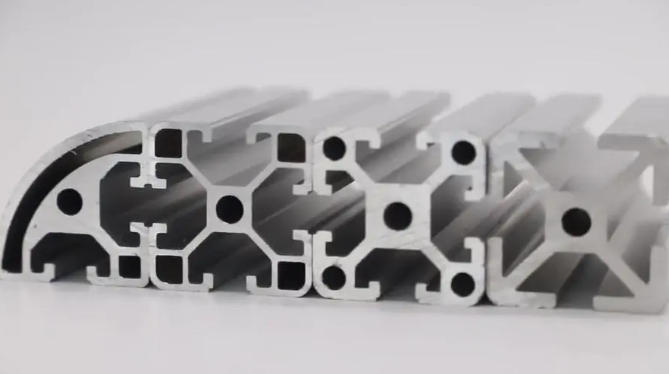
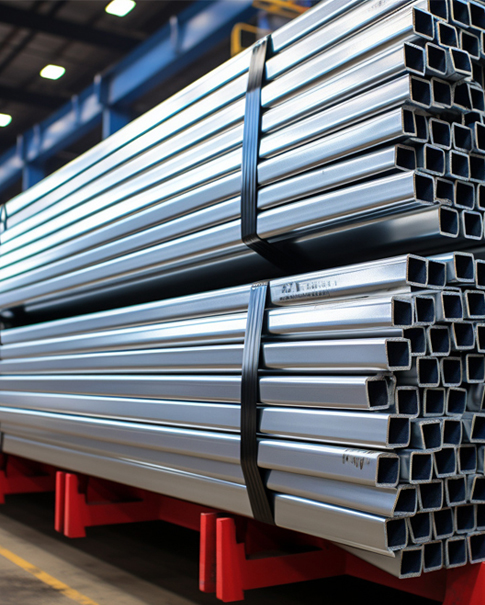
You must systematically evaluate aluminum profile manufacturers prior to signing supply contracts. Securing high quality and long-term reliability requires auditing operational capabilities alongside technical product standards. First, inspect factory certifications, automated technology, production equipment, and plant capacity. Every competent aluminum extrusion manufacturer meets strict operational guidelines. Second, audit physical output directly. You must verify alloy purity, dimensional tolerances, surface finish thickness, and structural strength. A qualified aluminum extrusion manufacturer delivers superior industrial aluminum profiles consistently. Evaluating every manufacturer thoroughly protects your structural projects from costly operational failure. Choosing the correct aluminum profile manufacturer guarantees total project success.
Key Takeaways
-
Check factory ISO certifications and modern equipment to ensure top manufacturing standards.
-
Verify aluminum alloy purity and dimensional accuracy using precise laboratory testing tools.
-
Inspect surface coating thickness to protect aluminum profiles from harsh weather damage.
-
Test metal hardness and tensile strength to guarantee high structural load capacity.
Auditing Operational Capabilities of Aluminum Profile Manufacturers
You must audit factory infrastructure before finalizing your supply agreement. Leading aluminum profile manufacturers operate under strict international frameworks and deploy high-grade technology. Every qualified aluminum extrusion manufacturer provides transparent documentation regarding operational efficiency. This audit helps your procurement team evaluate industrial aluminum profiles for demanding structural uses. You can protect your business from costly project delays when you select an experienced manufacturer.
Key Audit Insight: Operating high-tonnage automated presses under certified process controls directly ensures uniform grain structure, accurate geometry, and predictable load-bearing capacity across every batch.
Compliance Standards and International Certifications
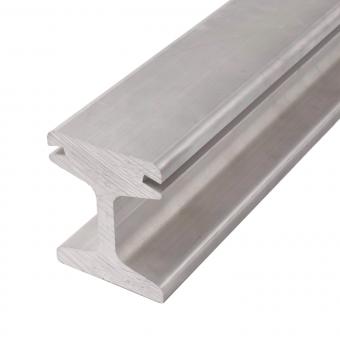
You should review quality management credentials during your initial plant evaluation. You must verify active iso 9001 certification to confirm structured process controls across all production stages. An active iso 9001 certification proves that a company maintains systematic records, calibrates tooling regularly, and audits internal workflows. You should also verify CE and TSE certifications to confirm adherence to global safety and manufacturing guidelines. A compliant aluminum profile manufacturers plant consistently enforces standardized procedures to lower defect rates.
Tip: Always request direct proof of iso 9001 certification from the auditing agency rather than relying solely on promotional brochures.
You must inspect specialized surface finishing credentials for architectural aluminum profile and industrial aluminum profile orders. QUALANOD and QUALICOAT quality marks confirm rigorous surface protection protocols.
|
Certification Standard |
Surface Treatment Scope |
Focus & Target Applications |
Core Testing Parameters |
|---|---|---|---|
|
QUALICOAT |
Powder or liquid organic coating on aluminum |
High-grade protective and aesthetic coatings for architectural components (e.g., doors, windows, facades) |
• Film thickness |
|
QUALANOD |
Anodizing (electrochemical oxidation) of aluminum |
Oxide layer depth control, sealing integrity, and appearance consistency |
• Dye spot testing |
A reliable aluminum extrusion manufacturer enforces strict layer limits to protect profiles against environmental wear:
-
Anodic Layer Thickness Requirements:
-
Indoor applications: 5–10 μm
-
Architectural applications: 10–15 μm
-
Industrial / Marine environments: 20–25 μm
-
-
Powder Coating Layer Requirement: 60–80 μm standard
-
Pre-treatment & Control: Chromating or chrome-free pre-treatment, cross-cut adhesion tests, impact resistance testing, and batch-wise thickness verification
Advanced Extrusion Machinery and Automation
Modern extrusion plants rely on computer-controlled equipment to ensure dynamic precision. You must evaluate the technological investments of every prospective aluminum extrusion manufacturer. Automated machinery eliminates manual errors and protects overall quality during heavy press operations.
|
Feature / Aspect |
Automated Extrusion Technology |
Manual Machinery |
|---|---|---|
|
Control System |
Utilizes real-time closed-loop sensor feedback to instantly adjust parameters like ram pressure, speed, and die temperature. |
Relies on human monitoring and manual setup, lacking real-time continuous dynamic adjustments. |
|
Cross-Sectional Consistency |
Keeps profiles within strict, tight tolerances by automatically countering parameter drifts without delay. |
Prone to variance and inconsistencies due to delayed human intervention and operator dependence. |
|
Operational Speed & Accuracy |
Speed dynamically auto-corrects (e.g., in response to die temperature changes) to protect profile integrity. |
Adjustments are reactive, periodic, and less precise, increasing the risk of profile deformation. |
Heavy industrial aluminum profiles require robust extrusion machinery. You must verify press tonnage capacity based on your structural engineering specifications.
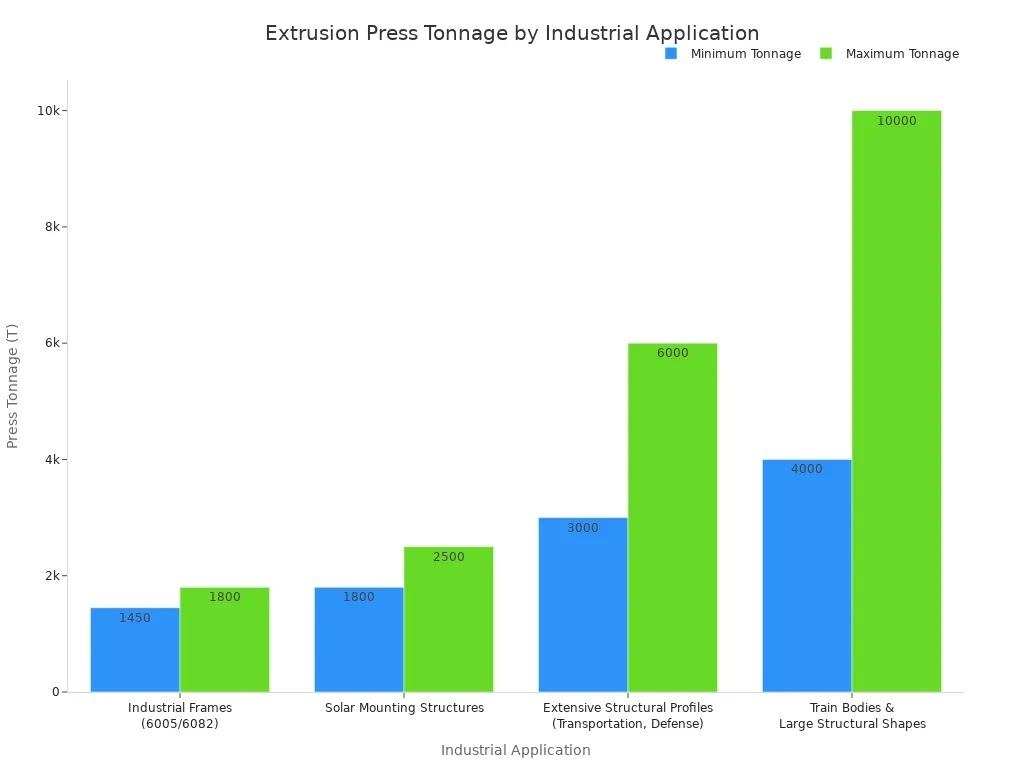
A top-tier aluminum extrusion manufacturer operates a range of presses to build diverse profile geometries. Industrial framing components require 1,450 to 1,800 tons of press force. Solar mounting systems demand press capacities between 1,800 and 2,500 tons. Massive structural shapes for transportation and defense require 3,000 to 6,000 tons. Large train bodies require massive presses reaching 4,000 to 10,000 tons.
Custom Engineering Capacities at GUANGYA ALUMINIUM
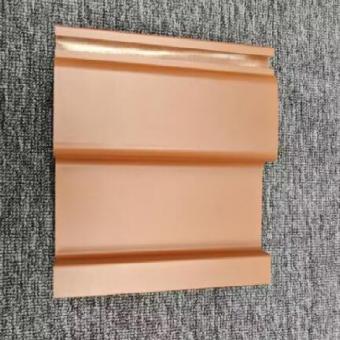
GUANGYA ALUMINIUM serves as an industry benchmark for complex manufacturing needs. As a leading aluminum extrusion manufacturer, GUANGYA ALUMINIUM maintains over 70 advanced extrusion lines. Their press capacities range from 600 tons up to 5,500 tons. This high-capacity press lineup easily handles complex industrial custom orders and standard aluminum extrusions.
You gain access to 200 sets of key production equipment when you partner with GUANGYA ALUMINIUM. Their engineering team provides expert craftsmanship to match exact engineering drawings. The factory produces 500,000 to 700,000 tons of aluminum products annually across its main production bases.
A tier-one aluminum profile manufacturer must combine high volume with flexible engineering support. GUANGYA ALUMINIUM combines large-scale capacity, custom tooling design, and strict quality control under one operational system. Choosing an established aluminum extrusion manufacturer minimizes your structural risks and ensures stable supply chains for every major project.
Evaluating Industrial Aluminum Profiles Quality and Tolerances
You must evaluate physical output directly to verify structural integrity. Leading facilities deploy non-destructive testing (NDT) methodologies before shipping finished goods. Advanced technicians utilize ultrasound scanners and X-ray imaging to detect internal voids, hidden cracks, and inclusions. Automated visual inspection systems inspect every exterior surface continuously during production. These optical sensors flag minor scratches, die lines, and micro-cracks instantly. Combining non-destructive scanning with rigorous quality control protocols prevents defective parts from reaching your assembly line. Every reliable aluminum extrusion manufacturer performs these initial checks to guarantee structural safety.
Inspection Priority: Non-destructive ultrasound and automated visual imaging eliminate hidden internal voids before your team conducts permanent destructive material testing.
Alloy Selection and Chemical Composition Verification
You must confirm elemental purity before accepting mass production shipments. Chemical composition testing uses optical emission spectrometers and laboratory analysis prior to production and shipment. Technicians measure and confirm the precise proportions of elements like magnesium, silicon, and iron. Rather than testing for absolute purity, this process ensures the material strictly adheres to the exact elemental percentage criteria required for standard 6061 and 6063 alloy formulations.
An experienced aluminum extrusion manufacturer certifies chemical composition for every melt lot. Proper elemental ratios ensure ideal heat treatment response and long-term mechanical performance. You protect your structural applications by demanding certified spectrographic test reports for all industrial aluminum profiles.
Dimensional Accuracy and Wall Thickness Inspection
You must enforce strict dimensional accuracy across every custom extrusion cross-section. High-speed assembly systems require tight geometry and consistent wall thickness. Standard commercial extrusions often exhibit dimensional variations that cause installation failures.
You can verify strict tolerance parameters by comparing vendor outputs against established industrial standards:
|
Profile Category / Operation |
Dimension Type |
Applicable Tolerance |
|---|---|---|
|
Profile Application Standards |
Precision / Ultra-Precision |
Ranges from Precision to Ultra-Precision class based on application (e.g., aerospace, heat sinks) |
|
Typical Post-CNC Machining |
Linear Dimensions |
±0.05 mm to ±0.10 mm |
|
Fine/High-Precision Machining |
Selected Features |
±0.02 mm |
Precision alignment demands rigorous wall thickness verification. A competent aluminum extrusion manufacturer utilizes digital calipers and optical comparators to verify cross-sectional geometry. You maintain seamless assembly quality when your supplier consistently delivers high dimensional accuracy. Procurement managers should specify exact tolerance tiers when ordering complex industrial aluminum profiles.
Surface Treatment Film Thickness and Uniformity
You should inspect every surface treatment layer to prevent environmental degradation. Anodized layers and powder coatings shield the metal core against aggressive atmospheric elements. A disciplined quality control framework measures coating thickness across multiple contact points.
For severe exterior exposure, you must require specialized anodizing depth ratings:
-
CA 1 Classification Requirements:
-
Target Anodized Layer: 15–20 microns
-
Recommended Environments: Heavy rainfall, high humidity, coastal developments, and high-rise facades
-
Primary Protection Purpose: Superior UV protection and long-term corrosion resistance
-
Different operational environments demand tailored surface protection protocols:
|
Environmental Severity |
Recommended Coating Thickness |
Primary Protection Purpose |
|---|---|---|
|
High Durability / Exterior Duty |
20–25+ microns |
Weathering and industrial pollution resistance |
|
Coastal, Marine, & High Humidity |
25–30 microns |
Superior defense against saltwater, moisture, and extreme corrosion |
Powder coating applications require identical analytical precision. You must audit finished batches using standardized physical test protocols:
|
Test Parameter |
Equipment / Standard Method |
Acceptance Criteria / Description |
|---|---|---|
|
Film Thickness |
Calibrated thickness gauge (electromagnetic induction type) |
Measured using precision equipment rather than visual inspection to ensure target thickness. |
|
Cross-Hatch Adhesion |
ASTM D3359 standard test method |
Requires scoring the finish, applying and stripping adhesive tape, resulting in minimal flaking (rated 4B or 5B, with 5B required for exterior exposure). |
-
Qualicoat Class 1 Requirements: Architectural aluminum finishing standards mandate a minimum film thickness of 60 µm.
-
Adhesion Rating: Must achieve a classification 0 rating according to the ISO 2409 cross-hatch adhesion standard.
A top-tier aluminum extrusion manufacturer maintains active liquid coating lines alongside anodizing baths. Inspecting these protective layers ensures your industrial aluminum profile and architecture aluminum profile orders withstand harsh outdoor weather. Superior surface finishing extends product service life significantly.
Testing Mechanical Properties of Industrial Aluminum Profiles
You must mandate destructive material testing to verify internal structural strength. Physical loading tests confirm whether temper conditions meet project engineering specifications.
Webster hardness testing provides immediate feedback regarding temper heat treatment quality:
|
Temper |
Webster Hardness Range |
Yield Strength Requirement |
|---|---|---|
|
6063-T5 |
8–11 HW |
— |
|
6063-T6/T66 |
10–13 HW |
— |
Yield strength testing establishes actual load capacity limits:
|
Temper |
Minimum Yield Strength (Rp0.2) |
Typical Hardness / Strength Notes |
|---|---|---|
|
6063-T5 |
≥110 MPa |
Minimum ≥8 HW (typically 130–150 MPa actual yield strength) |
|
6063-T6 |
≥180 MPa |
Higher strength requirement standard |
Destructive tensile testing verifies the ultimate tensile strength of extrusions by placing a prepared metal specimen into a Universal Testing Machine (UTM). The apparatus clamps both ends of the sample and applies a continuously escalating uniaxial pulling force by separating the crossheads at a regulated velocity, precisely tracking load and elongation until full structural fracture occurs.
You should audit the exact tensile test workflow:
-
Specimen Extraction & Preparation: Standardized "dog-bone" test specimens or machined bars are sectioned directly from the extruded profile according to specific gauge length and cross-sectional dimensions.
-
Fixture Mounting: The prepared specimen is locked into hydraulic grips within a designated tensile testing apparatus (such as Instron or Zwick equipment).
-
Controlled Pulling: Mechanical force is applied to pull the sample at a fixed strain rate, recording stress-strain data continuously through yielding up to mechanical failure/fracture.
-
Property Determination: Key mechanical indicators are extracted from the recorded data curve, specifically identifying the Ultimate Tensile Strength (UTS) as the maximum peak stress endured prior to rupture, alongside yield strength (0.2% proof stress) and ductility/elongation percentages.
-
Standard Compliance Verification: The procedure adheres to defined industrial testing standards, including ASTM B557 and ISO 6892, to confirm structural quality, heat treatment, and alloy temper.
Comprehensive material testing proves that your industrial aluminum profiles can support critical dynamic loads. A capable aluminum extrusion manufacturer maintains calibrated testing laboratories directly on site. Integrating continuous quality control across raw material selection, extrusion, surface finishing, and mechanical testing guarantees exceptional product quality for every heavy structural order.
Establishing Reliability and Long-Term Supplier Performance
You must secure long-term operational success by verifying supplier consistency. A dependable aluminum profile supplier delivers uniform parts across all production batches. You protect your business from supply disruptions when you partner with a verified aluminum extrusion manufacturer.
Procurement Audit Strategy: Regular stage-by-stage factory inspections ensure stable output, lower defect risks, and improve supply chain management.
End-to-End Quality Control and Stage Audits
You should evaluate how an aluminum extrusion manufacturer controls daily operations. A qualified aluminum extrusion manufacturer implements strict quality control procedures from raw billet heating to final heat treatment.
|
Manufacturing Stage |
Quality Control Checkpoints |
|---|---|
|
Raw Billet Inspection & Heating |
• Verify chemical/alloy composition |
|
Extrusion Setup & Execution |
• Inspect die condition and validate press settings |
|
Quenching & Stretching |
• Verify adequate cooling rate |
|
Aging Furnace Process |
• Perform hardness and temper verification |
Rigorous quality control safeguards the mechanical integrity of industrial aluminum profiles. Every skilled aluminum extrusion manufacturer tracks these key operational steps closely.
Supply Chain Stability and Lead Time Management
You must evaluate delivery timelines before placing orders for industrial aluminum profiles. Reliable delivery schedules prevent downtime in your primary factory production. You can establish performance benchmarks by evaluating prospective vendors against standard industry lead times.
|
Phase / Order Complexity |
Lead Time Benchmark |
|---|---|
|
Tooling Creation & Validation |
Adds 1 to 4 weeks (up to 2 to 6 weeks before full production) |
|
Small Volume & Simple Profile |
4 to 8 weeks after tooling approval |
|
Medium Volume & Standard Profile |
6 to 10 weeks after tooling approval |
|
Large Volume & Moderate Complexity |
8 to 12 weeks after tooling approval |
|
New Tooling & Complex Profile |
10 to 14+ weeks total |
An experienced aluminum extrusion manufacturer maintains raw aluminum stock to shorten lead times. Evaluating schedule adherence guarantees overall supply chain reliability.
On-Site Audit Checklists and Vendor Scoring
You should execute structured factory audits before selecting aluminum profile manufacturers. A top aluminum profile manufacturer welcomes transparent operational scoring during vendor evaluations.
Your team must inspect these critical operational categories:
-
Supplier Information & Background: Assessing basic company ownership, location, ISO certifications, total production capacity, and historical compliance performance.
-
Quality Management Systems (QMS): Reviewing standard quality policies, training records, document controls, and real-time process monitoring controls.
-
Safety and Regulatory Compliance: Evaluating personal protective equipment enforcement, emergency preparedness, hazardous material handling, and safety standards.
-
Production & Quality Control Records: Verifying process documentation, adherence to SOPs, inspection logs, corrective action tracking, and calibration records.
-
Operations & Risk Management: Checking routine equipment maintenance logs and performing structured risk assessments.
|
Inspection Category |
Key Evaluation Criteria / Metrics |
Inspection Methods & Tools |
|---|---|---|
|
Visual Surface Quality |
Scratches, dents, discolorations, and aesthetic integrity |
Direct visual inspection |
|
Surface Roughness |
Microscopic surface smoothness (e.g., Architectural: 0.8 µm, Industrial: 1.2 µm, Automotive: 0.5 µm) |
Profilometer measurement |
|
Coating & Anodizing |
Uniformity of color, coating thickness, UV exposure, and corrosion resistance |
Film thickness gauges |
|
Subsurface Integrity |
Cracks, internal defects, and structural soundness |
Dye penetrant testing |
|
Mechanical Properties |
Strength, hardness, ductility, and performance under stress |
Tensile, hardness, impact, and fatigue testing |
|
Material Traceability |
Tracking raw material lots to finished goods via inspection reports and material certs |
Batch tracking & documentation audit |
Standardizing your quality control evaluation guarantees superior output for every custom industrial aluminum profiles batch. Partnering with a leading aluminum extrusion manufacturer ensures long-term operational success for your business.
You safeguard your structural supply chain by combining on-site factory audits with rigorous laboratory testing.
Evaluating operational capabilities alongside physical testing guarantees superior product quality and supplier reliability. Partnering with a verified aluminum extrusion manufacturer like GUANGYA ALUMINIUM minimizes structural risks and lowers your total cost of ownership. An audited aluminum profile manufacturers facility delivers high-grade industrial aluminum profiles for complex architecture aluminum profile and industrial aluminum profile projects. Standardize your procurement team's internal quality control protocols today. Choosing an experienced aluminum extrusion manufacturer ensures long-term performance for every aluminum component.
FAQ
How do you verify raw aluminum billet standards?
Procurement Tip: Always request chemical analysis sheets prior to mass production.
You must request mill test certificates directly. Inspect spectrometry reports to verify aluminum alloy composition. This step ensures your structural components achieve high quality.
What press capacity does an aluminum profile manufacturer need for heavy orders?
You should select heavy press lines for major structural projects. Large shapes require presses between 3,000 and 6,000 tons. These machines shape complex industrial aluminum profile designs easily.
Why should you audit an extrusion facility on site?
On-site audits reveal real operational standards. You inspect automated machinery, verify testing protocols, and check inventory. Direct inspection confirms whether an aluminum extrusion manufacturer maintains consistent production for your architecture aluminum profile orders.
How does anodizing protect aluminum extrusions outdoors?
Anodizing builds a protective shield across metal surfaces:
-
Layer Depth: Increases thickness up to 25 microns.
-
Corrosion Resistance: Blocks salt spray and moisture penetration.
This protective aluminum oxide layer shields raw aluminum components against aggressive corrosion and wear.
What tolerances should you expect for custom aluminum frames?
Custom structural aluminum frames require tight dimensional parameters. You must define tolerance tiers during engineering reviews. Qualified aluminum processing facilities keep linear dimensions within ±0.05 mm.